
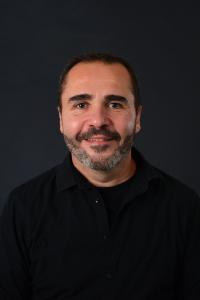
Pedro García-Caro
Education
Ph.D. 2004, King's College London, University of London
M.A. 1997, University College London, University of London
B.A. (Hons) 1996, University of Surrey, Roehampton (University of Roehampton since 2004)
Licenciatura en filosofía y letras (Filología Moderna) 1995, Universidad de Murcia
Research Interests
Pedro García-Caro is Professor of Spanish and Department Head of Romance Languages at the University of Oregon. His research explores the cultural and political afterlives of empire across the Americas and the Atlantic world, examining how literature, intellectual history, and political thought shape debates about nationhood, colonialism, memory, and environmental change.
Trained in Spain, the United Kingdom, and the United States, García-Caro works across comparative literature, cultural history, and the environmental humanities. His scholarship investigates how writers, artists, and intellectuals have responded to imperial decline, modernization, and extractive capitalism from the nineteenth century to the present.
He is the author of After the Nation: Postnational Satire in the Works of Carlos Fuentes and Thomas Pynchon (2014; Spanish edition, 2025), a comparative study of literary critiques of nationalism and Cold War political culture. He is currently completing a book on postcolonial Spain and the cultural politics of imperial decline, as well as a project on mining, extractivism, and environmental imaginaries in the Americas.
A significant strand of his work focuses on archival recovery and textual editing. His research has contributed to the preservation and study of U.S. Hispanic literary heritage through the recovery of overlooked transatlantic archives and early Spanish-language texts. He edited Astucias por heredar un sobrino a un tío (2018), an eighteenth-century play by Fermín de Reygadas and the earliest known Spanish-language drama performed in colonial California, helping bring renewed attention to a neglected chapter of literary and cultural history in the American West.
His current editorial projects include a critical edition of La verdad sobre el proceso de José Antonio Primo de Rivera, the memoirs of Federico Enjuto Ferrán, the investigating judge in one of the most consequential political trials preceding the Spanish Civil War. This work contributes to ongoing debates about historical memory, fascism, and the origins of modern Spain.
García-Caro is co-editor of Transatlantic Studies: Iberia, Latin America, Africa and serves as General Editor of Periphērica: A Journal of Social, Cultural, and Literary History. At Oregon, he teaches courses on Latin American, Spanish, and transatlantic cultures, encouraging students to connect literary interpretation with broader questions of history, power, and social change.
Publications


1. Books
- La verdad sobre el caso José Antonio Primo de Rivera, memorias del juez instructor. Introduction and co-edition with Cecilia Enjuto-Rangel. Granada: Editorial Comares. Forthcoming.
- Astucias por heredar un sobrino a un tío by Fermín de Reygadas (1789). Critical introduction, edition, and notes. (Houston: Arte Público Press, 2018).
- Transatlantic Studies: Iberia, Latin America, Africa. Introduction and edition with Cecilia Enjuto Rangel, Sebastiaan Faber, and Robert Newcomb. Liverpool University Press, 2019. A collective volume on methodologies and topics in Translatlantic Studies.
- After the Nation: Postnational Satire in the Works of Carlos Fuentes and Thomas Pynchon. (Evanston, Ill.: Northwestern University Press, 2014)
From the book-cover:
“After the Nation is an extraordinarily rich book that encompasses more than literary criticism—the cultural history of divergent nations that cannot or should not be ignorant of each other’s culture nor of its dissident voices.”—Jean Franco, from the foreword.
“Exemplary in its inter-American scope, well-conceived and clearly written, this book offers an innovative framework to investigate a wide array of interrelated American topics—border crossing, modernity, enlightenment, postcolonalism, exceptionalism—that have shaped the works of Carlos Fuentes and Thomas Pynchon and, by extension, of many contemporary U.S. and Latin American writers.”—Alejandro Herrero-Olaizola, Arthur F. Thurnau Professor of Spanish and Latin American Studies at the University of Michigan and author of The Censorship Files: Latin American Writers and Franco’s Spain.
After the Nation proposes a series of groundbreaking new approaches to novels, essays, and short stories by Carlos Fuentes and Thomas Pynchon within the framework of a hemispheric American Studies. García-Caro offers a pioneering comparativist approach to the contemporary American and Mexican literary canons and their underlying nationalist encodement through the study of a wide range of texts by Pynchon and Fuentes which question and historicize in different ways the processes of national definition and myth-making deployed in the drawing of literary borders. After the Nation looks at these literary narratives as postnational satires that aim to unravel and denounce the combined hegemonic processes of modernity and nationalism while they start to contemplate the ensuing postnational constellations. These are texts that playfully challenge the temporal and spatial designs of national themes while they point to and debase “holy” borders, international borders as well as the internal lines where narratives of nation are embodied and consecrated.
Reviews of After the Nation:
- West, Ty. A Contracorriente: "Transnational Genealogies and Post-national Literary Canons." 12. 2 (2015): 455-461.
- Castañeda García, Daniel. Literatura mexicana 26.2 (2015): 139-143.
- Juan-Navarro, Santiago. "Review of After the Nation. Postnational Satire in the Works of Carlos Fuentesand Thomas Pynchon by Pedro García-Caro." The Latin American Literary Review 43.85 (2015) 109-112.
- Janzen, Rebecca. García-Caro, Pedro. "After the Nation: Postnational Satire in the Works of Carlos Fuentes and Thomas Pynchon. Evanston, IL: Northwestern University Press, 2014." TRANSMODERNITY: Journal of Peripheral Cultural Production of the Luso-Hispanic World, 6.1 (2016). ssha_transmodernity_30933.
- Castany Prado, Bernat. Revista Iberoamericana, XVI, 62 (2016): 268-70.
- Delden, Maarten. "After the Nation: Postnational Satire in the Works of Carlos Fuentes and Thomas Pynchon by Pedro García-Caro (review)." Revista de Estudios Hispánicos 50.1 (2016): 263-265.
- Wallace Shawn, La fiebre/The Fever A Bilingual Edition/Edición bilingüe. Ed. and trans. by Pedro García-Caro in collaboration with Rafael Spregelburd (Paris: Les editions du Paquebot, 2012).
Books in progress
- Postcolonial Spain: The Cultural Politics of Imperial Amnesia. Under contract with publisher.
- Undermining Empire: Mining Literature and the Aesthetics of Natural Determination.
2. Selection of articles, chapters in books
- “Malinche o la nostalgia imperial disfrazada de comedia pop” Lo imposible, 2 (June 2026).
- “The Fabrication of a Hero: José Antonio Primo de Rivera’s Trial and its Afterlife in Franco’s Propaganda Machine.“ Journal of Spanish Cultural Studies, vol. 25, num. 4 (2025).
- “The Strange Case of a “Lost” Dramatic Performance: Early Californio Literary Culture and Anglo-American Historiographic Censoring.” in Latinx Literature in Transition. Ed. by Kenya C. Dworkin and Elisa Sampson Vera Tudela. (Cambridge: Cambridge University Press, 2025), 341-362.
- “Early Ecofeminism in Spain: El metal de los muertos (1920) and Mineros (1932), (anti)Mining Literary Interventions by Concha Espina, Carmen Conde, and María Cegarra.” In A Companion to Spanish Environmental Cultural Studies, ed. by Luis I. Pradanos (London: Tamesis, 2023) 159-168.
- “Memory Laws or Gag Laws: Disinformation Meets Academic Freedom” Editors’ Introduction. With co-editor Michael Dreiling. Journal of Academic Freedom, Vol 13, Fall 2022.
- “Testimony and Chronicle in Elena Poniatowska’s Las mil y una... La herida de Paulina.” Teaching Late-Twentieth-Century Mexican and Chicana Writers. Ed. by Elizabeth Coonrod Martínez. (New York: MLA, 2021), 60-68.
- “Introduction: Staking out the Field.” Transatlantic Studies: Iberia, Latin America, Africa. With co-editors, Cecilia Enjuto-Rangel, Sebastiaan Faber, and Robert Newcomb. (Liverpool: Liverpool U.P. 2019), 1-19.
- “Triangulating the Atlantic: Blanco White, Arriaza, and the London Debate over ‘Spain.’” Book chapter for Transatlantic Studies: Iberia, Latin America, Africa. (Liverpool: Liverpool U.P. 2019), 178-191.
- “A Play for Branciforte: Early California and the Survival of Astucias por heredar un sobrino a un tío, a Banned Comedia from Bourbon New Spain.” Early American Literature 53, no. 3 (2018): 773-884.
- “Performing to a Captive Audience: Dramatic Encounters in the Borderlands of Empire.” The Cambridge History of Latino/a American Literature, ed. by John Morán González and Laura Lomas. (Cambridge: Cambridge University Press, 2018), 51-73.
- "Luvina" y la teoría política de Juan Rulfo. Monteagudo: Revista de literatura española, hispanoamericana y teoría de la literatura 22 (May 2017). 89-95.
- “Aura y la teoría narrativa de Carlos Fuentes.” En breve: la novela corta en México. Ed. por Anadeli Bencomo y Cecilia Eudave. (Guadalajara: Universidad de Guadalajara, 2014), 143-157.
- “Entre occidentalismo y orientalismo: la escritura estereográfica de la Revolución mexicana en España. El militarismo mejicano (1920) de Blasco Ibáñez y Tirano Banderas (1926) de Valle-Inclán.” Revista Hispánica Moderna 65.1 (June 2012). 9-31.
- “Las minas del Rey Fernando: plata, oro, y la barbarie española en la retórica independentista hispanoamericana.” Anales de Literatura Hispanoamericana 40 (Fall 2011). 39-59.
- “España, última colonia de sí misma: la justicia en el exilio.”L'exil espagnol dans les Amériques. Ed. Ernesto Mächler Tobar et al. Paris: Indigo et Côté-Femmes, 2011. 51-66.
- “Entre familiaridad y exotismo: un episodio (trans)nacional de Benito Pérez Galdós.” Special Issue: “España en armas: Culture of Wars/War of Cultures” Vanderbilt e-Journal of Luso-Hispanic Studies, 4 (Winter 2009). 57-71.
- “La nueva izquierda y la agonía del nacionalismo mexicano en La muerte de Artemio Cruz.” Alma América. Vol. I Ed. Vicente Cervera Salinas and María Dolores Adsuar. Murcia: Universidad de Murcia, 2008. 287-304.
- “‘America was the only place…’ American Exceptionalism and the Geographic Politics of Pynchon’s Mason & Dixon.“ The Multiple Worlds of Mason & Dixon. Ed. Jane Hinds. New York: Camden House, 2005. 101-124.
- ”Damnosa Hereditas: Sorting the National Will in Fuentes’ The Death of Artemio Cruz and Pynchon’s The Crying of Lot 49.” How Far Is America From Here? Ed. Paul Giles, Theo D’Haen, Djelal Kadir, and Lois Parkinson Zamora. Amsterdam, New York: Rodopi, 2005. 323-345.
- “Behind the Canvas: The Role of Paintings in Peter Ackroyd’sChatterton and Arturo Pérez Reverte’s The Flanders Panel.“ Crime Scenes: Detective Narratives in European Culture since 1945. Ed. Anne Mullen and Emer O’Beirne. Amsterdam, New York: Rodopi, 2000. 160-170.
- “Under Western Eyes: D.H. Lawrence’s Mexico.” Proceedings of the 22nd International Conference of AEDEAN. Ed. Pere Gallardo and Enric Llurda. Lleida: Editions de la Universitat de Lleida, 2000. 281-286.
3. Reviews, interviews.
- Review of Cervera Salinas, Vicente. Borges en la ciudad de los inmortales. (Sevilla: Renacimiento, 2015). Hispamérica, 45.
- Review of Claudio Lomnitz The Return of Comrade Ricardo Flores Magón (New York: Zone Books, 2014). Transmodernity: Journal of Peripheral Cultural Production of the Luso-Hispanic World, 5:2 (2015): 119-124.
- “The Uncertain Territory of Memory: A Conversation with Chilean Writer Roberto Brodsky” in collaboration with Lisa DiGiovanni. World Literature Today, September 2012.
- The Death of Carlos Fuentes: An Impossible Silencing Act. In Memoriam (1928-2012). A Contracorriente, Vol. 9, No. 3, Spring 2012, i-x.
- “Más allá del silencio.” Revista de la Universidad de México. Número 100 (Junio 2012). 65-69.
- “Hacer bien el oficio: La escritura y los olvidados. Entrevista a Elena Poniatowska.“ Cartaphilus, 7 (2010). 255-266.
- “Written in the Margins: ‘Doing the Job Right’. An Interview with Elena Poniatowska“ A Contracorriente, 7: 4 (Fall 2010). 349-370.
- “Exorcising the Lettered City: The Literature of the Villista Revolution. A Review of Max Parra’s Writing Pancho Villa’s Revolution.” A Contracorriente: A Journal on Social History and Literature in Latin America 5: 1 (2007): 215-227.
- “Review of Mexicanos: A History of Mexicans in the US by Manuel G. Gonzales.” Comparative American Studies: An International Journal, 2: 2 (2004): 252-4.
- “‘Anaqueles Caseros’: Entrevista a Unai Elorriaga.” Ciberletras, 9 (July 2003): http://www.lehman.cuny.edu/ciberletras/v09/garcia-caro.html
- “Lujuria Roja: Aub visto por Ripstein.” Ciberletras, 10 (December 2003): http://www.lehman.cuny.edu/ciberletras/v10/garciacaro.ht
4. Other collaborations and publishing projects
- Managing Editor for Periphērica: Journal of Social, Cultural, and Literary History.
- Co-editor with Michael Dreiling of the Journal of Academic Freedom (2021-23).
- Roundtable on Astucias por heredar with theatre Director Robi Arce at Portland State University (February 2018).
- Interviewed on US/Mexico border for Flaunt Magazine Issue 114 (Spring 2011)
- Interviewed on La fiebre/The Fever on Puerto Rican Radio Station program 123 Probando: Part 1 and Part 2 January 2013.
- Discussant Community Conversations: Día de Muertos
Curator for Photo Exhibit at the Jordan Schnitzer Museum of Art of"David Maawad. Shining Rock / Resplandor de Roca" (April 3-29, 2012) and at the UO White Stag Building, Portland (May 3-June 9, 2012)
Editor, Les Editions du Paquebot. Contact us directly here.