
How the Strategy Was Developed
Starting in 2024, College of Arts and Sciences leadership began working on a strategy that will guide the college over the next five years. To ensure the strategy is inclusive and representative of the views of the faculty, staff and students who make up the CAS community, the college’s leadership held town halls and formed a 13-member committee to guide the process.
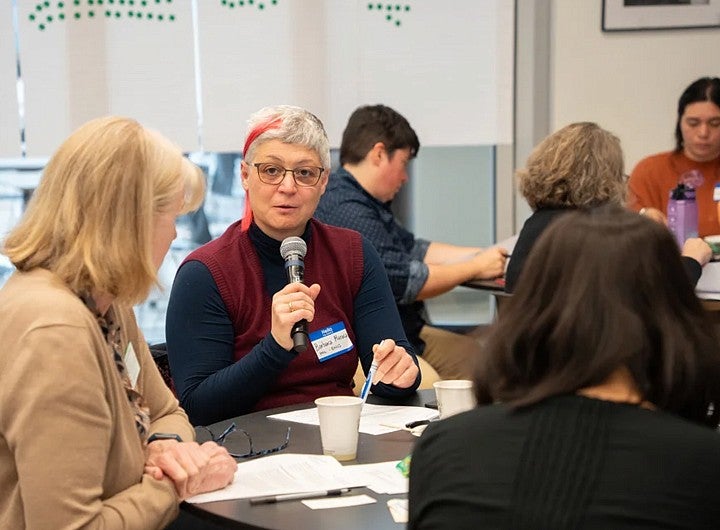
During the blueprint stage of the College of Arts and Sciences’ strategy development, faculty and staff provided feedback and ideas at CAS Community Conversations.
More than 100 faculty, staff and students helped develop the key strategic priorities that will serve as the college’s guiding star in the years ahead at CAS Community Conversation events.
Today’s students will most likely switch careers multiple times throughout their lifetime, and a liberal arts education promises to prepare them for that. One question that arose during strategy development sessions conversations was: How can we be sure we’re giving students a true liberal arts education?
“We’re very much wanting to look at the core curriculum and take it apart, start over and reshape it,” Poulsen said, adding that CAS needs to make liberal arts relevant in the 21st century. “What does the future look like if AI is a presence? How can we weave computer science and data science throughout the college? And what are our values, and are they different from what they were yesterday?”
“Our strategic plan is a chance for us to reflect on who we are as a community and what makes us distinctive,” Poulsen said. “We’ll use it to set high-level directions that align to our mission and guide our resource allocation.”
CAS Strategy Timeline
Since the College of Arts and Sciences began developing its strategy, it has engaged with its community of stakeholders. This was so the college could incorporate as many voices and input into the strategic planning creation process. This engagement period was filled with enthusiastic feedback from our alumni, campus leaders, faculty, graduate and undergrad students, and staff.
Winter/Spring 2024
CAS Dean's Office leadership hosts conversations to hear ideas from CAS community for strategic plan
Summer 2024
- Vision, mission, and values identified
- Working groups begin to draft strategic priorities
Fall 2024
CAS leadership seeks input on strategic priorities, finalizes them
AY 24/25
CAS Dean's Office drafts detailed strategic implementation plan including steps to achieve strategic priorities, owners, and measures of success
AY 24/25
Work begins on draft tactics in strategic implementation plan
Fall 2025
Strategic implementation plan is finalized
Winter 2025
Dean Chris Poulsen presents strategic implementation plan to CAS community at town hall
The Steering Committee Who Guided the Process
The College of Arts and Sciences strategic planning process included voices and perspectives from our community. A 13-member steering committee represented departments and programs in CAS and assisted in the development and finalization of the strategy process.