
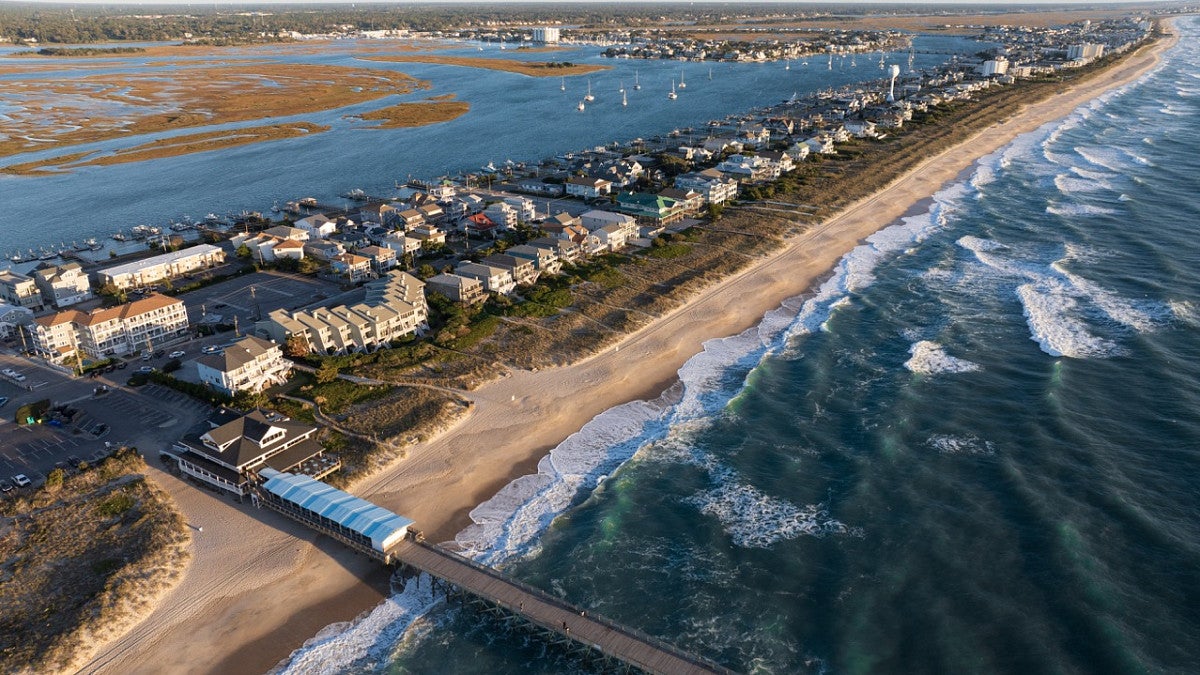
From the tip of Maine to the bottom of Florida, the US Eastern Seaboard is home to a significant amount of valuable real estate. But over the next few decades, a rising tide of flood risks threatens one of the most populous regions of the US.
From fire to weather events, risks to property and homes isn’t new. That’s why homeowners’ insurance exists. But flood risk insurance isn’t a common policy that American homeowners and property owners have. Flood insurance is only required for homes with federally regulated mortgages that are designated as high-risk flood areas by the Federal Emergency Management Agency’s maps.
“The housing market is a massive market in the US,” said Laura Bakkensen, an economist in the College of Arts and Sciences (CAS). “It's worth trillions of dollars. That value means we need to think about some of these natural disaster risks and how they're affecting some of our financial systems.”
Bakkensen is the Mikesell Professor in Environmental and Natural Resource Economics in CAS who studies the economics of natural disasters. Her recent work focuses on what rising sea levels could mean for US real estate, banking and insurance companies — all foundational entities of the national and global economy.
Who bears the risk of climate change’s impact on housing?
As climate change continues to pose a threat to a large swath of US properties, Bakkensen recently explored what rising sea levels mean for the housing market.
“The big questions are what is the magnitude of the risks and who bears the risk,” Bakkensen said. “There’s an increasing attention and awareness that others — besides homeowners — bear risk of this property loss. And mortgage lenders are an important part.”
This is what Bakkensen and her co-authors explored and reported on in “Leveraging the Disagreement on Climate Change: Theory and Evidence,” published in the Journal of Political Economy.
The article’s co-authors are economists Toàn Phan and Tsz-Nga Wong , both of the Federal Reserve Bank of Richmond .
Which housing market is most impacted by rising sea levels?
According to the US Census Bureau, about one-third of the country’s population lives on coastal lands that could be impacted by climate change-related floods due to rising sea levels, erosion and weather-related disasters.
Whereas the West Coast tends to faces coastal erosion and the Gulf Coast faces sinking land in addition to sea level rise, Bakkensen found the East Coast an intriguing case. The coast is home to a stock of homes that has a high monetary value on the US real estate market. The sea level on the East Coast is expected to rise twice as fast as the West Coast over the next 30 years.
Even at a modest projection of 1.5° Celsius global temperature increase, the United Nations expects sea levels to rise and impact the world’s coastal regions. As the global temperature gets hotter, oceans warm. That warming then causes impacts like the melting of glaciers and ice sheets, which then causes sea levels to rise and impact areas like the East Coast.
What is the financial risk related to climate change and housing?
Bakkensen and her co-authors looked at 90 million outstanding loans across the US held by government-sponsored enterprises (GSEs), such as Fannie Mae and Freddie Mac. What they found was that about one-quarter were located in areas with some flood risk, which is about $2.2 trillion in value. That monetary amount wouldn’t all be lost, but it would impact the US and global financial markets.
Flood insurance can help to manage risk but only about four percent of U.S. properties have insurance. Most flood insurance policies are held through the National Flood Insurance Program, created by US Congress in 1968, and are managed by FEMA. However, the program’s fiscal health has been questioned by lawmakers. It’s carrying $22 billion in debt and is nearing its debt cap of $30 billion, according to a March 26, 2026, US House of Representatives Financial Services Committee Housing and Insurance Subcommittee hearing.
“Most flood insurance is a federal product, and that’s interestingly not true in all countries,” Bakkensen said. “There is a very small but growing private flood insurance market, so it’ll be interesting to see what that looks like over time.”
Mortgages typically get packaged and sold to other finance companies, including GSEs. However, GSEs are not allowed to include geographic factors like flood risk into how they price and purchase mortgages. That means the risk of owning mortgages for properties facing sea level rise could be spread throughout the housing finance market.
Who is most likely to lose their home due to climate change?
Bakkensen also conducted a search of home sales within one kilometer (.62 miles) of the East Coast, a likely range for properties at risk for damage from rising sea levels. Bakkensen’s previous work has shown that higher income white residents tend to own properties in the US at risk for coastal flooding and lower-income and diverse demographics own properties with inland flood risk.
What the authors found was that people who are more pessimistic about sea level rise are more likely to take out a longer-term mortgage, even if they have means to buy in cash. Most real estate properties are purchased with a 30-year loan, but when someone pays in cash, they have full equity — and liability — for the property.
“It's a very rational strategy,” Bakkensen said. “You'd rather share the risk with the bank rather than bear it all yourself.”
A mortgage typically requires the property owner to carry homeowners insurances to protect the bank. But flood insurance isn’t required unless the mortgaged property is in a federal government recognized flood map. Having a mortgage for property also offers last-ditch coverage: default. Bakkensen and coauthors find that defaults are more likely after a disaster.
“Nobody wants to default on their mortgage,” Bakkensen said. “If a terrible disaster event occurs, the idea of this research suggests that the costs of defaulting on your mortgage would be less than having to bear the cost of the disaster losses all yourself.”
— By Henry Houston, CAS Communications