

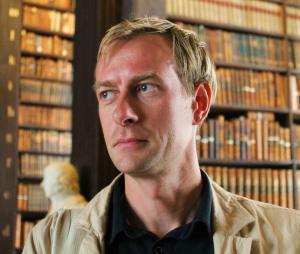
Colin Koopman
Statement
Colin Koopman's research, writing, and teaching focuses on political theory and ethics, particularly the politics and ethics of technology. His current research is concerned with the politics of information, that is, with questions about data and democracy. He explores these fields in terms of both century-old paper database technologies and contemporary techno-trends like artificial intelligence. Methodologically, Koopman's research mobilizes analytics and concepts from the philosophical traditions of genealogy and pragmatism to engage current issues of politics, ethics, and culture. From a metaphilosophical perspective, his work is expressive of a pluralistic practice of philosophy that draws widely on diverse figures, traditions, disciplines, and themes. He has written on a range of figures across genealogy (Foucault, Nietzsche, Williams) and pragmatism (James, Du Bois, Dewey, Rorty, Brandom) as well as other thinkers in Continental (Deleuze, Habermas, Latour) and Analytic (Wittgenstein, Rawls, Anderson) philosophy. His work also engages research in other disciplinary contexts by media scholars, historians, anthropologists, political scientists, legal theorists, and information scientists.
Research
Dr. Koopman's current recent research is focused on the politics of data technologies. This work is represented in the following publications and profiles:
- Data Equals: Democratic Equality and Technological Hierarchy. When we gave algorithms power over our world, we hoped that the apparent neutrality of machine thinking would create a more egalitarian age. Yet we are more divided than ever, staring down threats to democracy itself. Data Equals mobilizes philosophical pragmatism (by way of John Dewey, W.E.B. Du Bois, and Elizabeth Anderson) to show that data technologies are failing our democracy because we built them around a deficient notion of equality.
- How We Became Our Data: A Genealogy of the Informational Person. Contemporary socio-technologies of information are mediated by a form of subjectivity emergent in the twentieth century. Mobilizing a project in philosophical genealogy (largely by way of Michel Foucault), How We Became Our Data presents historical studies of the early years of scientific personality psychology (ca. 1917-1937), the racialization of real estate appraisal practices in America (ca. 1923-1934), and the history of identification paperwork (ca. 1913-1933). Summaries of parts of the book are available in:
- A profile of Koopman in The New York Times by David Marchese (2023).
- An early preivew piece on 'Infopolitics' from the New York Times (2014) and a more recent New York Times piece on Facebook's Cambridge Analytica scandal (2018)
- Or, see his talk on "Infopolitics" at his undergrad alma mater (The Evergreen State College, a small public lib arts college in WA state)
The Our Data, Our Selves web project brings together some of his individual and collaborative research on the genealogies of data systems and their ongoing functions in our historical present.
Publications
Books:
- Data Equals: Democratic Equality and Technological Hierarchy, University of Chicago Press, Sept. 2025
- How We Became Our Data: A Genealogy of the Informational Person, University of Chicago Press, 2019 (see a review symposium at Syndicate: Philosophy)
- Genealogy as Critique, Indiana University Press, 2013 (see a review symposium in Foucault Studies, no. 18)
- Pragmatism as Transition, Columbia University Press, 2009 (see a review symposium in Contemporary Pragmatism in 2017 published upon the paperback release)
Articles and Essays:
- On Data Politics:
- The most recent publication in this area is "Artificing Intelligence: from Isolating IQ to Amoral AI" in the journal AI & Society, a piece tracing the amorality of contemporary AI implementations to their reliance on conceptions of intelligence standardized in the predecessor technology of the IQ test. Other research in this area, some of which has recently appeared in the book Data Equals, includes an article on the histories of data-driven inequality in the milieu of W.E.B. Du Bois and Francis Galton (in Theory, Culture, & Society) and an article arguing for a political theory of formats, aka data structures (in Political Theory).
- A distillation of the contributions to media theory and media historiography offered in How We Became Our Data appears in "Information before information theory: The politics of data beyond the perspective of communication" in New Media and Society
- A distillation of the contributions to political philosophy offered in How We Became Our Data appears in "Infopolitics, Biopolitics, Anatamopolitics" at the Graduate Faculty Philosophy Journal.
- Some arguments from the book are also summarized in two short pieces in The New York Times: "The Age of 'Infopolitics'" and "How Democracy Can Survive Big Data."
- On Genealogy and Pragmatism:
- A recent piece on analytic genealogy, contrasting contingency-attentive empirical genealogy with teleology-oriented functional genealogy, published in the journal Mind: "Genealogy, Empirical History, and Functional Teleology".
- A summary of a few key ideas from Koopman's first two books on philosophical methods is available in a précis article titled "Genealogical Pragmatism".
- Representative scholarship on figures in the history of philosophy include are a pair of companion papers on Foucault's genealogy in Critical Inquiry (in the Summer 2013 issue) and in Constellations (in the December 2015 issue), and another pair of companion papers on James's pragmatism in Journal of the History of Philosophy (in the July 2017 issue) and in diacritics (in a 2016 issue).
- Other publications on genealogy and pragmatism have appeared in journals including: Critical Inquiry, diacritics, Journal of the History of Philosophy, Metaphilosophy, The Review of Metaphysics, Constellations, Philosophy & Social Criticism, The Transactions of the Charles S. Peirce Society, The Journal of Speculative Philosophy, Contemporary Pragmatism, Foucault Studies, and elsewhere.
- Editorial projects on these topics have included a special issue on interdisciplinary uses of Foucault (in History of the Human Sciences), another issue on Foucault and Pragmatism (published in Foucault Studies), and a co-edited volume on Rorty and cultural critical philosophy (published by Bloomsbury [formerly Continuum]).
Website:
- For further details, please visit Colin Koopman's regularly updated website where you will find a complete list of publications: https://pages.uoregon.edu/koopman/.
Teaching
Dr. Koopman regularly teaches courses on the social impacts of technology (PHIL 123, PHIL 423), the philosophy of politics and law (PHIL 307, PHIL 344), as well as upper-level and graduate courses in his main areas of research.