
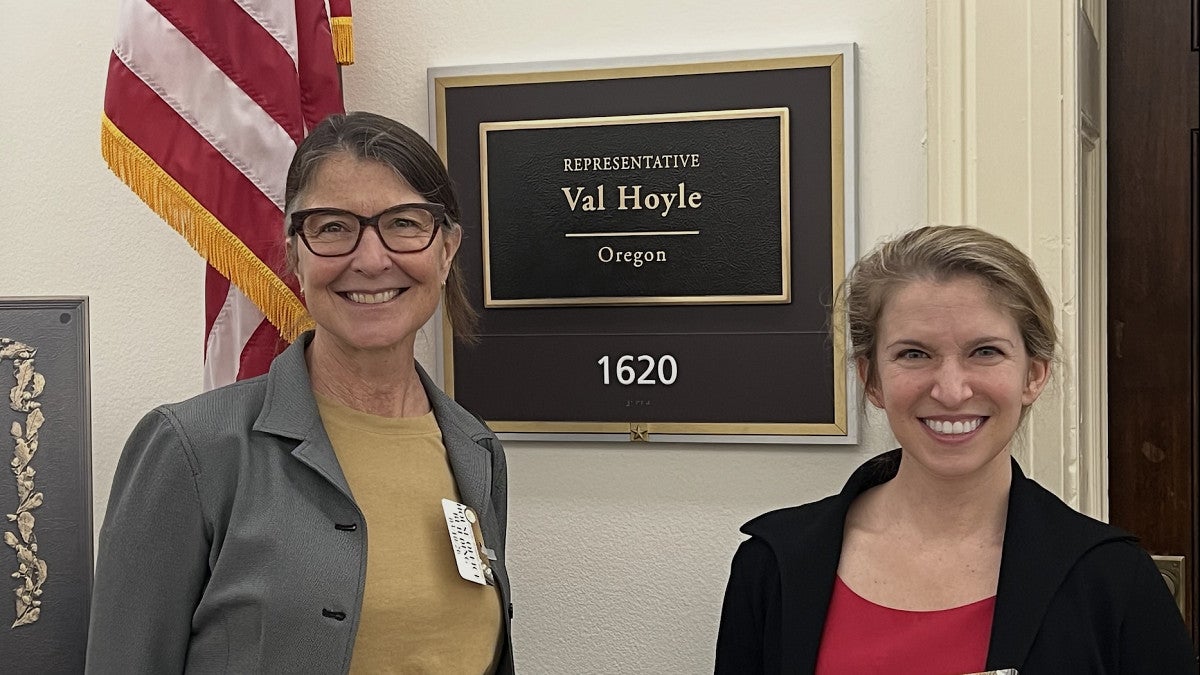
More than a year after the National Endowment for the Humanities (NEH) canceled approximately $175 million in grants nationwide, two College of Arts and Sciences (CAS) professors are feeling optimistic about the future of the humanities. Their optimism is a result of spending two days in Washington, D.C., advocating for the humanities with the National Humanities Alliance, where they found a high level of bipartisan support.
“Our visit to D.C. countered the narrative that the humanities are in decline,” said Leah Middlebrook, professor of comparative literature and Spanish and director of the Oregon Humanities Center (OHC) “It’s actually a huge moment for humanities.”
Diana Garvin, assistant professor in Italian and the Romance Languages department, experienced firsthand the impact of the NEH cuts when she lost $10,000 in funding for a research project she was working on in spring 2025. Her research examines the history of everyday life across Fascist Italy and Italian East Africa. She had arranged for a trip to Eritrea, Africa.
“There was a lot of work that went into arranging that international trip,” Garvin said. “It would have been impossible if the Office of the Vice President for Research and Innovation (OVPRI) hadn’t stepped up with a last-minute resilience grant.”
Finding community in the humanities
The first day, Garvin and Middlebrook attended the conference for faculty, administrators, and representatives from humanities organizations. They met people from all over the U.S. — 49 states sent representatives — and were able to speak to and make connections with many of them. It was both Garvin’s and Middlebrook’s first time making the visit as delegates from the UO. The conference was supported by OVPRI, the Office of Federal Affairs, CAS Divisional Associate Dean of Humanities Erica Bornstein and the OHC.
The theme was “Humanities in the U.S.” Middlebrook said discussion topics included AI and its growing impact on teaching in higher education, the cuts to the NEH and how philanthropy is stepping up to fill the funding void left by the federal agency.
“I was interested to see that my own classroom experience, including the impact of AI tools, was the same for many of the faculty representatives I talked to,” she said. “It was an opportunity to brainstorm and share solutions.”
Advocating for the humanities
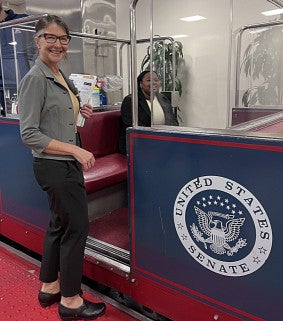
The next day Garvin and Middlebrook went to Capitol Hill to meet with Oregon congressional representatives and senators. Because Congress was not in session, they met with staffers in the offices of Sens. Jeff Merkley (D) and Ron Wyden (D), and Reps. Cliff Bentz (R), Maxine Dexter (D) and Val Hoyle (D). The goal was to specifically encourage their representatives to support the Cultural Caucus in the Senate, the Humanities Caucus in the House and funding for Title VI and Fulbright-Hays, international fellowships for U.S. citizens. These informal coalitions build support for humanities-related policies and legislation.
Garvin said attending was important because someone had to represent Oregon universities and communities.
“With any change in administration, the humanities require thoughtful, informed advocacy. But there is deep support right now,” said Middlebrook. “Congressional representatives and senators recognize the societal and global importance of the humanities. It’s a purple issue — not red or blue.”
Garvin pointed to Oregon’s strong support for the humanities across the state.
“One of the projects funded by the NEH is Historic Oregon Newspapers, which digitizes and preserves newspapers from communities across Oregon,” she said. “Communities in Oregon benefit from the program, and it’s widely used across Oregon, making it a great example of a purple humanities project.”
While the NEH funding issue has not been fully resolved, both professors feel emboldened by their actions.
“We need to keep sending representatives from the UO every year,” said Garvin. “It’s great for relationship-building, continuous communication and advocacy.”
— By Jenny Brooks, College of Arts and Sciences