
By Henry Houston, College of Arts and Sciences
—Mike Harms, Associate Professor and Director, Institute of Molecular Biology
The best research is not conducted alone. It takes collaboration, teamwork and outside perspectives to drive scholarship that innovates and advances the public good.
At the College of Arts and Sciences (CAS), faculty from various departments within the college and throughout the University of Oregon work in more than two dozen centers and institutes to produce research that is making an impact on Oregon and beyond.
CAS centers and institutes have wide-ranging research areas. They include sports performance, environmental resilience, and community and cultural benefit, among others. Reflecting diverse research areas, CAS’s centers and institutes can be found on the University of Oregon’s Eugene campus, the Oregon coast and central Oregon.
“Centers and institutes in CAS support our researchers as they embark on making a social impact with their scholarship. These research spaces also bring researchers near and far to come together to solve some of our biggest questions,” said Jennifer Pfeifer, psychology professor, co-director of the Center for Translational Research, and the CAS associate dean for Research and Scholarship. “Across the college, we have examples where the work being done is leading to impact, innovation and understanding the human experience.”
Native and Indigenous Languages Institute
Director, Robert Elliot
Native and Indigenous Languages Institute (NILI) is a community-driven center founded in response to requests from Tribal communities in Oregon and the Pacific Northwest to support Indigenous language revitalization. Many Indigenous languages in the region are critically endangered, and NILI works to help communities document, strengthen and restore languages for everyday use. These revitalization efforts not only strengthen cultural identity but help ensure these languages are passed on to future generations.
“Research at NILI is collaborative and community-centered,” Robert Elliot, director of NILI, said. “We partner with Native communities to develop resources, models and best practices that support language revitalization. Recognizing that there is no one-size-fits-all approach to language restoration, we work alongside communities as collaborators and advisors, helping identify strategies that fit local needs and goals.”
NILI works to share its research through presentations, community events and outreach, and storytelling. In 2025, NILI launched an annual film screening and panel discussion at the Art House Theatre, about a mile away from the UO’s Eugene campus, featuring language practitioners representing Indigenous languages of the region.
What’s key to NILI is student mentorship, Elliot said. Many student employees and researchers are members of Tribal communities who gain specialized experience in language documentation, education, research and revitalization practices.
“These opportunities help students build professional skills while supporting their communities, and many go on to leadership roles as language teachers, researchers and staff in Tribal language programs,” Elliot said.
Bowerman Sports Science Center
Director, Mike Hahn , professor of human physiology
Based in TrackTown, USA, The Bowerman Sports Center has access to a diverse pool of passionate participants, from Olympians to recreational athletes. Whatever their skills, researchers at the center apply human physiology in real-world sports to elevate human performance.
Director Mike Hahn said the work in the center works with members of the Eugene running community for research studies. Research involves local high school cross-country, track and field and soccer athletes, as well as the local professional soccer team, Cascades Football Club. Research staff and graduate students also support the Eugene-based Kidsports summer camps with “Science on the Field” workshops that cover the importance of nutrition, hydration and sleep for developing strong bodies and becoming capable athletes.
The research conducted at the center is directed by three Department of Human Physiology professors: Hahn, Chris Minson and John Halliwill. Post-doctoral scholars and doctoral students lead their own research efforts. But the center wouldn’t be what it is without its team of undergraduate students, who assist with research and develop their own independent research capacities. Many undergraduate alumni go on to enroll in medical school, join doctoral programs or work in the sports industry, Hahn said.
“Our work aims to make sport more attainable to the broader public and improve the individual athlete’s ability to increase their capacity to train and perform, thereby increasing health and well-being,” Hahn said.
Institute of Molecular Biology
Director, Mike Harms, associate professor, chemistry and biochemistry
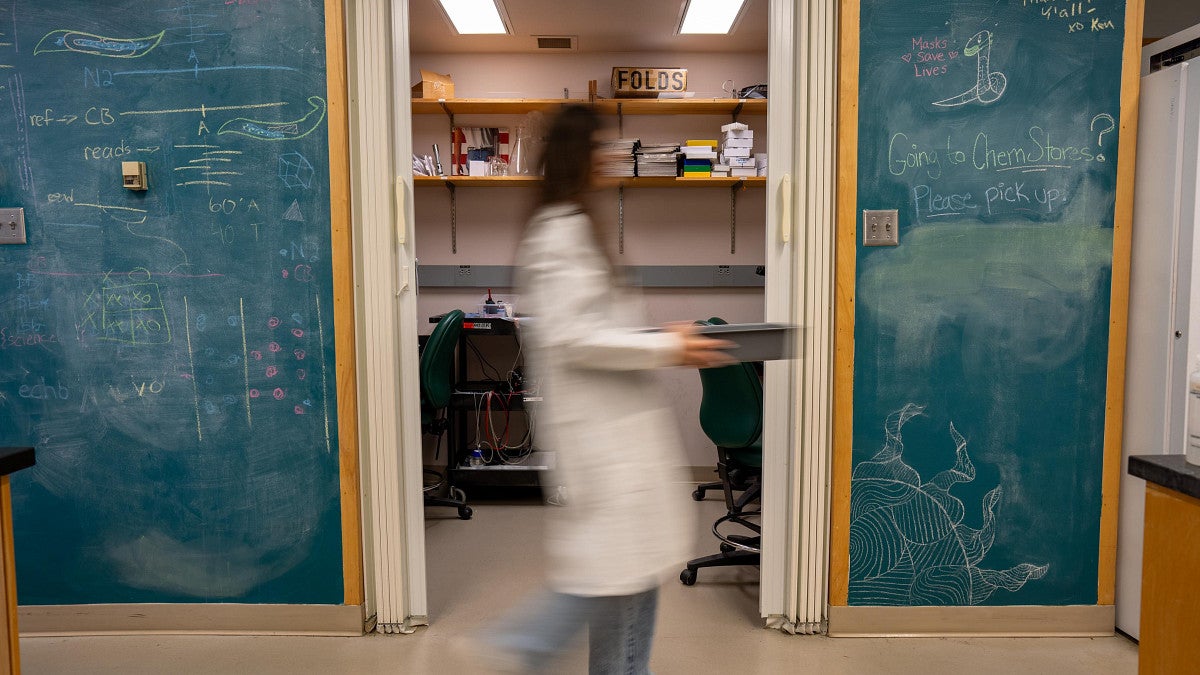
When a team of some of the University of Oregon’s most storied scientists founded the Institute of Molecular Biology in 1959, they wanted to create a collaborative place that could dissect the molecular underpinnings of living organisms.
That vision lives on. Today, IMB is an institution with biologists, physicists, chemists and more to understand life at the molecular level. Director Mike Harms said CAS researchers collaborate to work toward research that applies to human health-related issues, such as scoliosis.
IMB researchers look to various ways to present their work with the public. In 2020, biochemist Scott Hansen received a National Science Foundation award to help control cellular organization. In the spirit of IMB’s mission of cross-collaboration, the award supported collaboration with the College of Design and ArtSciOregon to train undergraduate researchers how to use visual arts to communicate about science and to educate the public about scientific research and methods.
Labs that are part of IMB include researchers of all levels: professors, postdoctoral researchers, graduate students and undergraduates. Harms said all researchers come together to generate a high output of research. In 2025, 75 research publications featured more than one IMB author.
“We want to tackle really hard important problems,” Harms said. “We're collaborating because if we're going to understand how life works at the molecular level, it takes more than one person — it takes a crew.”