
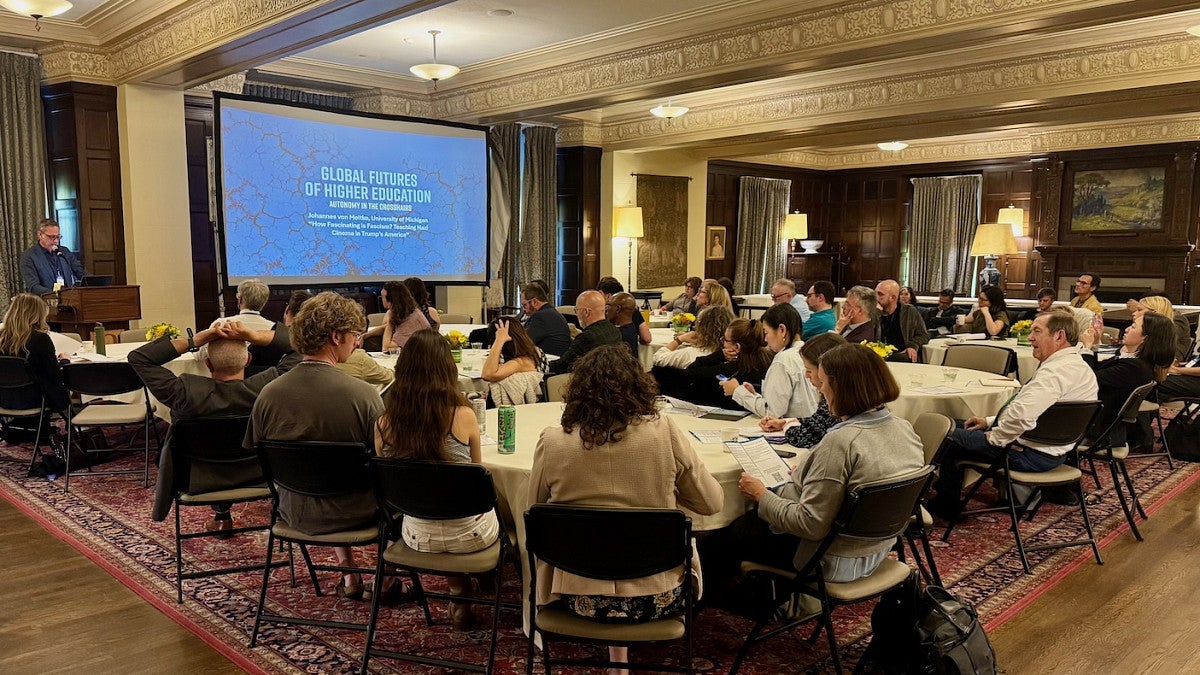
Around the world, scholars are confronting how authoritarian power reshapes higher education.
The “Global Futures of Higher Education: Autonomy in the Crosshairs” conference brought together 32 speakers to examine this challenge.
The event marked the launch of the Schnitzer School of Global Studies and Languages’ Center for Global Futures and its Global Futures conference series.
Speakers came from across the country — from New Hampshire to Georgia — and from abroad, including Canada and South Korea, to share perspectives on teaching and on resisting political pressure.
The Global Futures conference series was conceived by Aneesh Aneesh, executive director of the Schnitzer School. This year’s conference was co-organized by Matthias Vogel, Pedro García-Caro, Jina Kim and Andrea Romero Dugarte.
Christopher Long, provost and senior vice president, gave the opening remarks.
“The title of this conference, ‘Autonomy in the Crosshairs,’ is not hyperbole,” he said. “It is a diagnosis of an unmistakable global trend no longer isolated into regional skirmishes.”
Long described the university setting as carrying a fundamental guarantee that teaching and research are governed by evidence and argument. “Not,” he said, “by the ideological preferences of whoever holds power at a given moment.”
Aneesh said that discussions and shared education on this topic are necessary, “because the pressures on higher education aren’t isolated anymore; they’re global, fast-moving, and increasingly coordinated. If we don’t learn from one another across borders, we end up treating systemic threats to free inquiry as one-off controversies.”
While this story focuses on two sessions, the conference program content ranged widely, addressing curriculum wars, scholar safety, transnational repression, administrative governance and political economy, disinformation and public trust, and the implications of AI for higher education.
Two sessions that directly addressed the impact of authoritarian influence on higher education were “Teaching on/in Fascism” and “Administrative Power, Political Economy and the Remaking of Merit.”
Teaching on and in fascism
The panel, “Teaching on/in Fascism,” heard from educators who connect research on fascist culture, militarism, memory and pedagogy to current attacks on higher education and academic freedom. Together, they asked how instructors can teach histories of fascism in ways that remain historically grounded while addressing their urgency in the present.
Daniel Fried, professor of East Asian studies at the University of Alberta, spoke about self-censorship as resistance.
“Compliance is not necessarily capitulation,” said Fried. “And noncompliance is not necessarily resistance. There are forms of compliance that are strategic secrecy to evade repression.”
He discussed the specific methods of allegory, irony, code-switching, false personas, guest lectures and visible self-silencing as ways to get through to students.
Johannes von Moltke, professor of German studies and film, media and television at the University of Michigan, described his experience teaching Nazi cinema in today’s polarized political environment.
He began with words about the state of higher education.
“Although I've not personally had reason to be scared,” said von Moltke, “I want to acknowledge the chilling of campus speech and academic freedom and the climate of fear in which many of us, including close colleagues of mine, do our work.”
He made a case for carefully balancing the record of historical events along with reflection on what's happening in the present.
Lisa DiGiovanni, professor of contemporary Spanish and Latin American literature and film at Keene State College in New Hampshire, shared a video essay examining militarization, ideological encroachment, and threats to the survival of a sustainable, peaceful democracy
Jacqueline Sheean, assistant professor of Spanish at the University of Utah, addressed the impact of fascist ideologies on a nation’s history. She explained how fascist movements are deeply entwined with historical memory, and once in power, they reshape the nation’s relationship with its past to redefine national identity in the present. This directly affects higher education.
“The university is ground zero because it represents the foundation of our political culture,” said Sheean.
She provided the example of how Spain’s Franco regime produced a single-narrative “dictatorial memory” that revised the past, thereby restricting any critical examination of the nation’s history. In schools, teachers whose opinions differed were fired, regional languages were banned and the Spanish Civil War was taught as a holy crusade.
Restraint of academic autonomy
Another discussion panel at the conference was “Administrative Power, Political Economy and the Remaking of Merit.”
The presenters addressed how academic autonomy is constrained not only through overt repression, but also through routine administration, market pressures, and ideological redefinitions of merit and legitimacy. The panel drew on cases from South Korea, Bangladesh and Turkey to give a comparative view of governance under pressure.
Robert Hamilton, assistant professor of interpretation and translation at Hankuk University of Foreign Studies, has lived in Korea for 30 years. Hamilton’s presentation examined how academics in South Korea are held accountable to expectations through routine administrative processes rather than overt disciplinary action.
Drawing on internal evaluation documents and interviews, it shows how performance reviews, contract renewals and compliance systems quietly structure who remains legible and employable within universities.
“You teach with a continuous, low-level awareness of how and what you are doing might be read within a value within an evaluated framework,” he said.
Aras Koksal, doctoral candidate in sociology at the University of Minnesota, described how he developed the concept of "populist meritocracy.” Koksal analyzed how Turkey's Justice and Development Party has systematically challenged existing definitions of academic excellence by advancing an alternative framework rooted in cultural authenticity, Islamic piety and national mission.
This change has caused a massive expansion in the number of public universities as tools of political control, crackdowns on academic freedom and attacks on private universities that teach more perspectives than the one.
Satadru Bhattacharyya, a second-year sociology graduate student at the University of Connecticut, focused on higher education in India, where a site of ideological contention is evolving in which questioning the government is synonymous with being unpatriotic.
India’s government is a parliamentary democratic republic, but Bhattacharyya described it as facing a current juncture in which “subtle” fascism is presenting itself.
“They're systematically changing the curriculum that is being taught in schools at all levels,” said Bhattacharyya, “and rewriting our history in a way where national identity is tied to our religious identity.”
Resisting authoritarianism in higher education
This year’s conference represented the values of the Schnitzer School as a destination for timely conversations on urgent issues from a global perspective. It offered education and built camaraderie among a diverse body of educators passionate about the intersections of politics and education that exist everywhere.
Building on the panels, conference-goers learned about the manifestations of authoritarian influences on higher education, as well as tools to move forward with intention and strength.
“Universities have persevered through wars, revolutions, occupations and ideological capture,” said Long. “While it may have been reformed, defunded, shuttered and eventually reopened, what has persisted across centuries and across cultures is the animating conviction that knowledge pursued freely is worth having.”
Aneesh said the school will measure impact by what lasts after the closing session: collaborations, practical strategies institutions can use and stronger support networks. The broader Global Futures conference series is designed to track issues whose urgency is becoming clear.
“This year higher education; next year the future of work,” said Aneesh. “As AI reshapes labor markets and the institutions that prepare people to navigate them.”
— By Violet Ashley, College of Arts and Sciences