
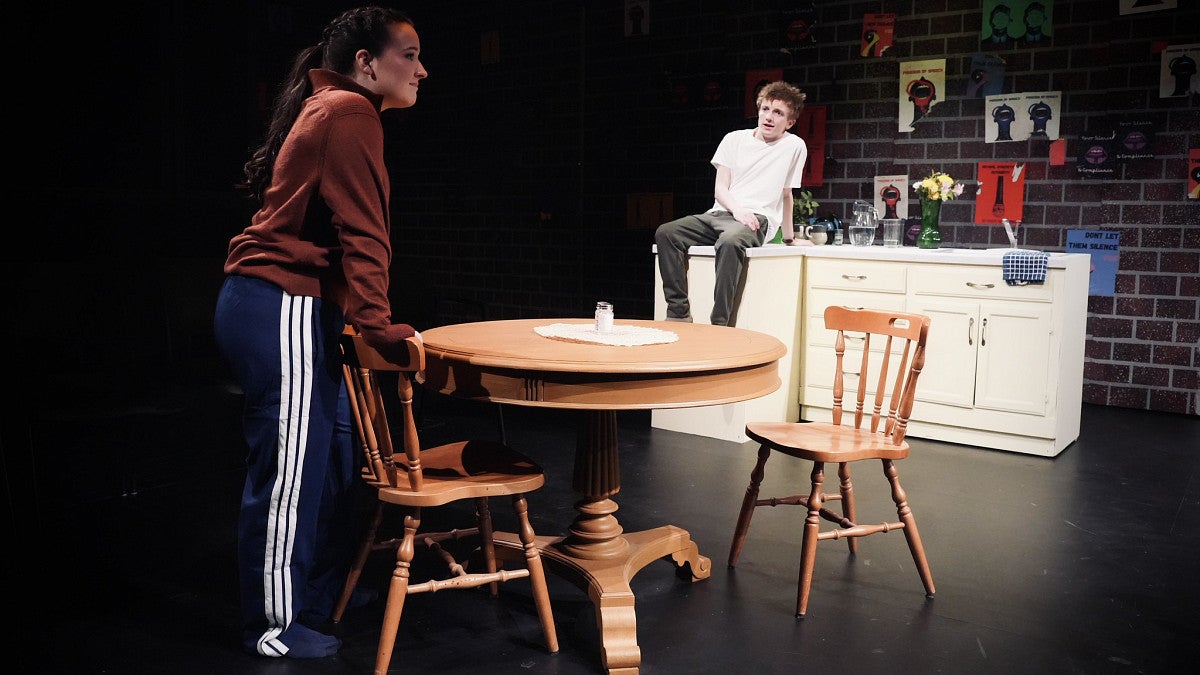
The College of Arts and Sciences Department of Theatre Arts is expanding opportunities for students to gain hands-on experiences and learn about different career paths. The most recent example is the student-run production of “Lemons, Lemons, Lemons, Lemons, Lemons” recently staged in the Pocket Playhouse and supported by a new student-director pilot program.
The plot of the play revolves around a couple, Oliver and Bernadette, who must cope with each other under a law passed by the new government that limits each person to 140 words per day.
Under these circumstances, the couple finds themselves trying to find alternative ways to communicate their ideas, emotions and issues with each other. There are numerous comic and dramatic scenes, as well as a portrayal of the challenges of expressing love, solving problems and sustaining intimacy under conditions of restricted communication.
Expanding opportunities for student directors
Directed by third-year student Logan Love, the production was entirely student-designed, featuring undergraduate lighting, scenic, props, sound, technical design and cinematography, alongside graduate student costume design and dramaturgy. The project exemplifies how collaborative leadership and mentorship prepare students for professional careers in theatre.
The student-director pilot program was created in response to undergraduate interest in expanding directing opportunities beyond assistant roles. Faculty advisor and Associate Teaching Professor Tricia Rodley explained that the initiative provided an option for a student-led directing project and provided mentorship to help students grow professionally.
“Directors collaborate across departments to bring a theatre project to an audience, and so it’s a unique leadership position in a production team. Like most other artists, directors build their skills or approaches over time. Early exposure helps guide career pathways at every level,” Rodley said.
The more ideas the merrier in theatre arts
Love was drawn to the play’s unconventional narrative and minimalist structure, which offered lots of creative freedom. “What drew me to it most was its non-linear fashion, so you see the growth and decay of this relationship between Oliver and Bernadette,” Love said. “And I really liked that when I first read it, I had no idea what was going to happen. I liked that it was very bare bones, and I could do a lot with it.”
The play’s structure presented both artistic opportunities and challenges. “I thought it would really keep audiences on their toes and engaged for the whole time. Especially when you're doing shows that are only two people, it's always the question of how these two people are going to stay interesting for 90 minutes. Is the audience going to stay engaged? And I think this script gave us a strong foundation to have a really engaging show.”
A key feature of the production was its student-led design. Love stressed the importance of communicating individually with each member of the creative team.
“I think it's really important when working with designers, especially students. Having that one-on-one time with them rather than traditional production meetings, which are for everyone,” Love said. “Giving that one-on-one time is really letting each designer kind of speak their perspective on the play, which I think is really fun when I'm directing.”
Rodley described Love’s dedication to the project as both rigorous and professional, especially given the challenge of directing a complex, non-linear production. The mentorship model allowed Love to stay creatively in charge while receiving guidance from faculty if needed.
For Love, the most meaningful aspect of the production was the entire team's dedication. “I think of all of the work that everyone put in; it just showed so greatly. And I think that is probably our biggest accomplishment, how hardworking a team we had and how beautiful their execution was,” said Love.
Making art that opens minds and opportunities
The production also encouraged audiences to reflect on both personal relationships and broader societal themes.
“What I hope audiences take away is, yes, that romantic and that connection that we have to these characters and their romantic relationships, but also acknowledging the political discourse of the play, seeing how different political perspectives play in a contemporary relationship and how we can see ourselves in that as well,” Love said.
The success of “Lemons, Lemons, Lemons, Lemons, Lemons” is an indication of how dedicated the Theatre Arts department is to practical training and preparing its students for their professional future. Participation in projects such as the student-director pilot program helps students learn and develop as emerging theatre professionals.
— By Harper Wells, College of Arts and Sciences