
—Scott Fisher, Physics Faculty, Director of Undergraduate Studies
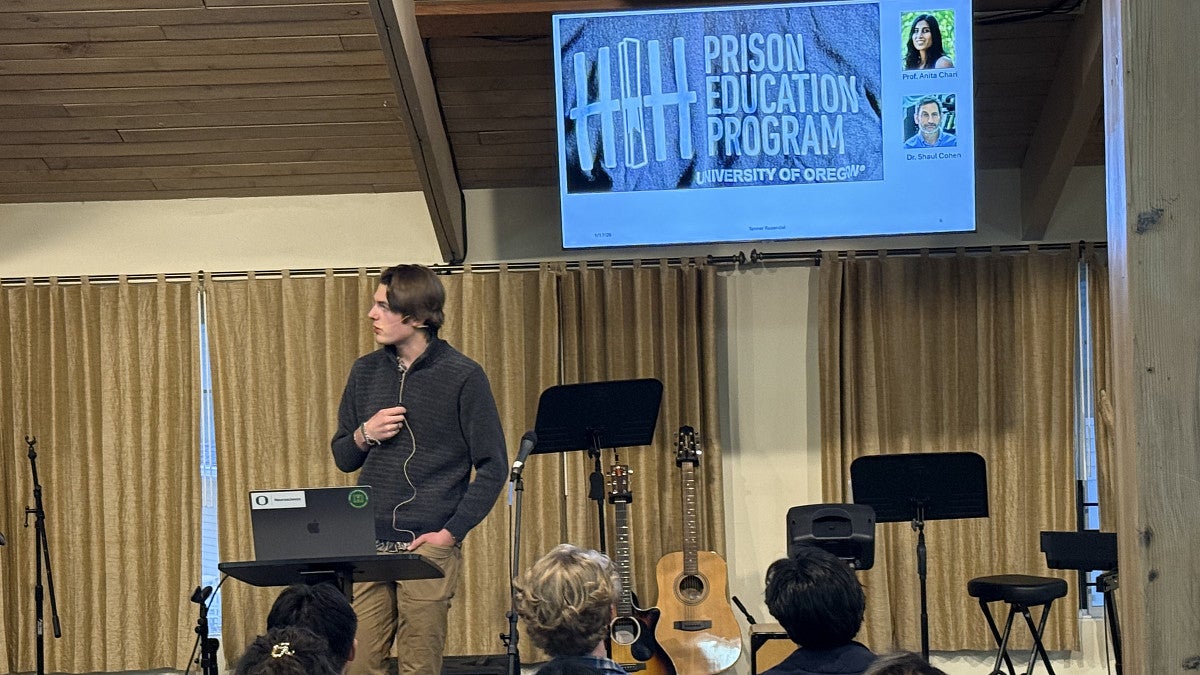
When Tanner Rozendal ’26 enrolled in Autobiography as Political Agency, a course offered through the University of Oregon Prison Education Program, he had no plans to pursue a career involving the criminal justice system. But as a neuroscience and human physiology double major preparing for a career in medicine, learning alongside incarcerated students in Professor Anita Chari's course challenged his assumptions about people, relationships and the practice of medicine.
“That single liberal arts class redirected my focus from viewing health solely through a clinical lab lens to addressing systemic public health needs,” Rozendal said.
As a result, he decided to pursue work in carceral health, care related to or provided in jail or prison. It is an example of how studying outside a STEM major can broaden students' perspectives and help them discover new ways to apply their scientific knowledge.
Why STEM students benefit from a broad liberal arts education
At the College of Arts and Sciences (CAS), students study disciplines across the natural sciences, social sciences and humanities. That breadth is central to a liberal arts education, which combines specialized knowledge with opportunities to explore different approaches to understanding the world.
Those different perspectives allow STEM students to balance the technical expertise developed in their majors.
“Ultimately, what we are trying to create are people who have a complementary combination of deep subject knowledge about their major or minor, well developed critical thinking skills and a desire for life-long learning,” said Scott Fisher, a faculty member in physics and director of undergraduate studies. “These goals can be most easily achieved when the student is exposed to many different ways of thinking.”
Fisher pointed to how scientific research itself requires creativity. Scientists must develop new approaches to problems, interpret findings and determine how to communicate complex information.
“While STEM majors work mostly in a fairly rigid realm — for example the laws of physics do not change — in research one often has to be creative to come up with a solution to a problem,” Fisher said.
Spending time studying other disciplines can give students additional perspectives to draw on when faced with unfamiliar challenges.
Understanding the human side of science
Technical expertise is also only one part of many STEM careers, particularly those involving health care.
“Something I tell students is that almost any STEM career you can think of involves some degree of human interaction,” said Nicole Dudukovic, teaching professor and director of the neuroscience major. “Exploring what it means to be human, through liberal arts coursework, allows you to navigate human interactions and relationships more successfully. That’s an important skill both for their careers and for life.”
Rozendal discovered that connection through Chari's course, which brought UO students together with incarcerated students to read philosophical texts and discuss personal experiences and broader social issues.
He entered the class with preconceived ideas about incarcerated people. Those assumptions changed as he came to know his classmates, many of whom became mentors and shared lessons from their own lives.
“My biggest revelation was the power of relationships,” Rozendal said. “Experiencing that class showed me that relationships are not optional; they are vital for survival, growth and healing.”
The experience prompted him to design a proposed six-week medical school rotation focused on carceral health. He has also worked with re-entry organizations to teach health literacy and has presented to physicians about compassionate, trauma-informed care.
Rozendal, who plans to enter medical school in fall 2028, now sees the relationships between health care providers and patients as central to effective treatment.
“Healing isn't just about applying a biological mechanism to a symptom; it relies on the human relationship between provider and patient,” he said.
How to make the most of a STEM education
For current STEM students, the lesson isn't to pursue less science. It's to recognize the opportunities that come from exploring subjects beyond their majors. CAS faculty like Fisher emphasize the benefits of taking a broad range of courses.
“Do not think of your GenEd classes as something to ‘just get through,’" he tells students. “Use those classes to broaden your knowledge and to learn different ways to approach learning and problem solving.”
He also encourages students to consider design courses that could strengthen their ability to communicate scientific data, foreign languages that could expand opportunities for collaboration, including studying and working abroad, and literature that could help them become stronger writers.
Dudukovic offers similar advice to students choosing courses beyond their major requirements.
“The thing I always tell students when they ask what additional courses to take beyond their major requirements is to take anything but more STEM courses,” she said.
Students will have opportunities for advanced technical training in graduate school or throughout their careers, she explained. College also offers an opportunity to explore unfamiliar disciplines, challenge assumptions and discover interests that might otherwise remain unexplored.
For Rozendal, one course outside his STEM majors did more than broaden his education. It reframed his view of health from managing disease to serving people, giving his clinical background a clear, human context.