
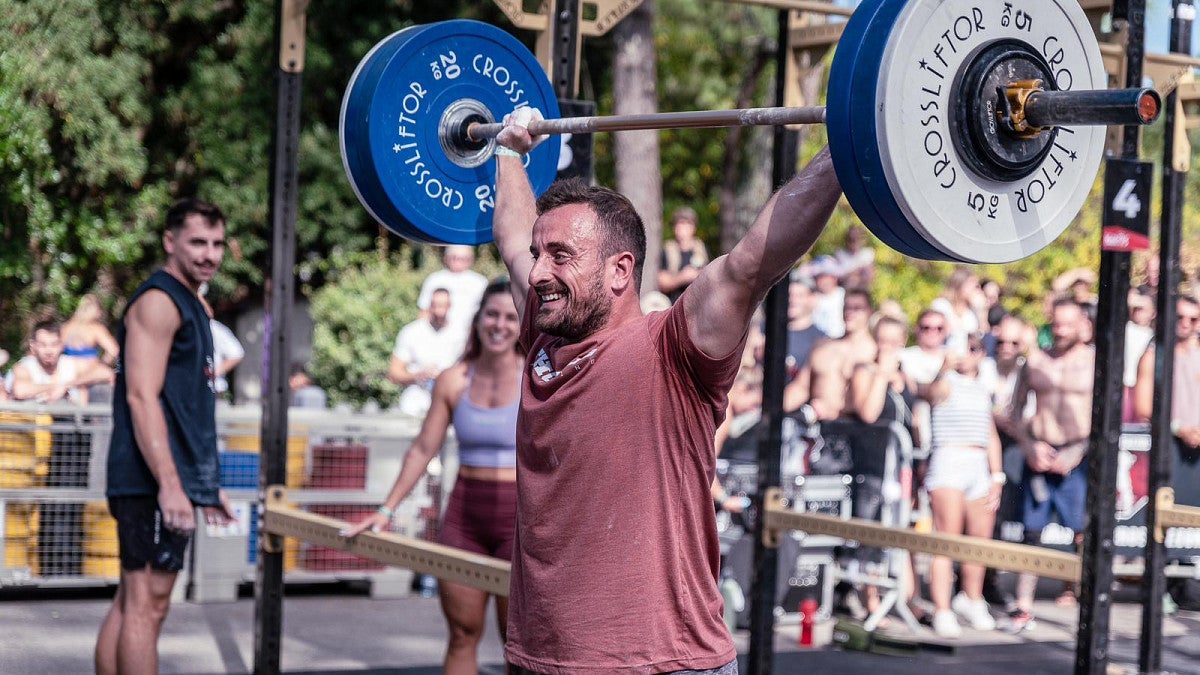
—Scott Mongold '21, Master's, Human Physiology
Scott Mongold MS ’21 (human physiology) didn’t come to the University of Oregon with a startup in mind. He came because he wanted to understand the human body: how it moves, how it adapts and how training changes it. As a competitive CrossFit athlete and a scientist, he was searching for a place where those two worlds didn’t have to be separate.
As a master’s student in the College of Arts and Sciences, he found what he was looking for, an intersection of sports and science. Drawn by the Department of Human Physiology and UO’s deep connection to athletics, Mongold saw an opportunity to study real people in real training environments instead of just in theory. It was the kind of place where he didn’t feel research was distant from application.
Learning how the body works and where science falls short
Mongold joined Assistant Professor Damien Callahan’s Muscle Cellular Biology Lab. He studied how resistance training affects muscle at both the cellular and whole-body level.
His work ranged from analyzing muscle tissue to using ultrasound technology to measure how muscles adapt over time, especially in populations often overlooked in research such as female athletes. But what stayed with him most was what the data he couldn’t fully explain.
“I realized that it’s not necessarily the size of your muscle — it’s the function of your muscle that’s important,” he said.
Working with both trained athletes and older adults, Mongold observed a pattern. People who stayed active throughout their lives maintained significantly better function, regardless of whether their training was highly structured or not.
At the same time, Mongold noticed something deeper. Even when muscles appeared strong, their control — how the brain coordinated movement — could break down, especially with age.
After graduating from UO, Mongold took his curiosity about the gap between muscle and the mind overseas to the Université libre de Bruxelles in Belgium. He pursued a doctorate in neuromechanics, combining neuroscience and biomechanics to study how the brain controls movement.
“I wanted to understand not just what muscles are doing, but what the brain is doing at the same time,” he said.
It was an extension of the scholarly foundation he built in CAS, one that allowed him to connect years of research into a more complete picture of human performance.
Building brains for the gym
As Mongold spent time in the lab, he couldn't ignore how fitness and strength training is talked about in the gym. The way people train and talk about fitness in the gym isn't always grounded in science. Advice in the gym spreads quickly and is often driven more by trends or marketing than by actual evidence.
“There’s a big mismatch between what is happening in labs and what is actually being consumed by people,” Mongold said.
After completing his doctorate, Mongold decided to try something that would increase scientific awareness. He founded umo, a platform designed to bring scientific insight — rooted in neuroscience — into everyday training.
Most fitness tools today rely on cardiovascular data: heart rate, sleep and step counts. What Mongold found missing in the fitness industry was an app for strength and power lifting athletes who want to track different biometric data. For strength and power athletes, performance depends heavily on the nervous system.
“The nervous system is one of the main contributors to your ability to learn a skill, develop strength and produce power,” he said.
Mongold’s app, umo, approaches that problem differently. Using a smartphone's already integrated features, it measures signals like reaction time and tremor to estimate fatigue and readiness, then adjusts training programs daily.
The idea is simple but powerful: training shouldn’t be static. It should respond to your day-to-day needs.
“If your program is individualized, you’ll progress better and reduce injury risk,” he said.
What a master’s from CAS made possible
Looking back, Mongold sees his time at UO as more than just a step in his academic path. It was where he learned how to think, collaborate and build.
As one of the first students in Callahan’s lab, he had a front row seat on how to create something from the ground up.
“I didn’t know it at the time, but it helped me understand how important communication is,” he said.
The master’s degree experience in the Department of Human Physiology shaped how he leads his startup, builds his team and translates science into something people can use every day.
Mongold is still growing umo. His sights are still set on changing how people think about human performance in the gym. Instead of one-size-fits-all programs, he is offering something more personalized, more scientific and more human.
“We have the potential to bring a completely different set of metrics to everyone,” he said.
That drive to improve human and sports performance, no matter a person’s level of athleticism, is what brought him to the UO. Now, he’s building something that puts that understanding into people’s hands.