
By Jenny Brooks, College of Arts and Sciences
Communities across the country are debating and defending the role mobile crisis response programs can play in their emergency response systems. Not all communities have them, but for those who do, measuring their impact is key to continued support and funding. Now, thanks to new research out of the College of Arts and Sciences (CAS), communities have what they need: a way to measure if and how much a program diverts calls from police.
This measurement is important because the crux of a mobile crisis response program is to divert non-emergency and non-violent 911 calls away from police for a chance to provide services and deescalate the situations before police resources are needed. Calls taken by mobile crisis response programs are usually about mental health, substance use, welfare checks and other issues that don’t require law enforcement.
The method for measurement was shared in a study, published in Science Advances, and used data from Eugene, Ore.’s, long-running CAHOOTS program. Using the formula to evaluate CAHOOTS, they found the program’s impact was substantially greater than some previous estimates suggested.
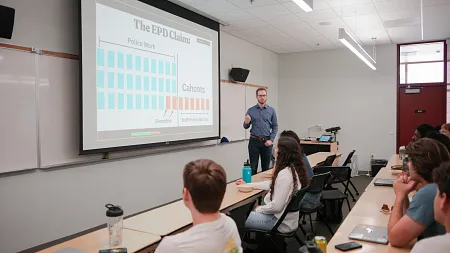
Rori Rohlfs, an associate professor of data science; Claire Herbert, an associate professor of sociology; and Nathan Burton ’24 (data science), a UO alum now pursuing a master’s degree at Johns Hopkins University, developed three standardized measures: the Substitution Diversion Rate, Prevention-adjusted Diversion Rate and Overlapping-mandate Diversion Rate.
Together, the measures give communities different ways to evaluate how mobile crisis programs affect demand for police services within their emergency response systems.
“Until now, there has been a lot of talk about programs’ ‘diversion rates’ without a clear, consistent definition,” Rohlfs said. “Our research defines what we mean by diversion and gives communities different ways to measure a program’s impact depending on the question they are trying to answer.”
Simply comparing call counts handled by police and crisis responders can be misleading because the two services don’t necessarily respond to the same kinds of calls. Programs also vary widely in their staffing, responsibilities and the types of calls they are equipped to handle.
The Substitution Diversion Rate measures mobile crisis program responses that directly replace police response; the Prevention-adjusted Diversion Rate additionally includes reduction in police responses likely due to prevention by early intervention by the mobile crisis program; and the Overlapping-mandate Diversion Rate looks specifically at calls that either police or the crisis program could handle. The research team also produced this video defining the data terms and research summary.
Applying the new measures to CAHOOTS, the researchers estimate CAHOOTS directly diverted 18% of calls that otherwise would have gone to Eugene police. When they accounted for calls that may have been prevented from entering the emergency response system because CAHOOTS was available, the estimated impact rose to 23%. CAHOOTS also handled nearly 50% of the calls that fell within the overlapping responsibilities of police and the crisis response program.
The researchers aren’t proposing a single benchmark for what a successful mobile crisis program should look like. Instead, their framework gives communities a consistent way to measure how their own programs fit within their emergency response systems.
“Mobile crisis programs across the country operate very differently, including who responds and what kinds of calls they are equipped to handle,” Herbert said. “These measures give communities a way to understand what their particular program is doing and how it affects the larger emergency response system.”
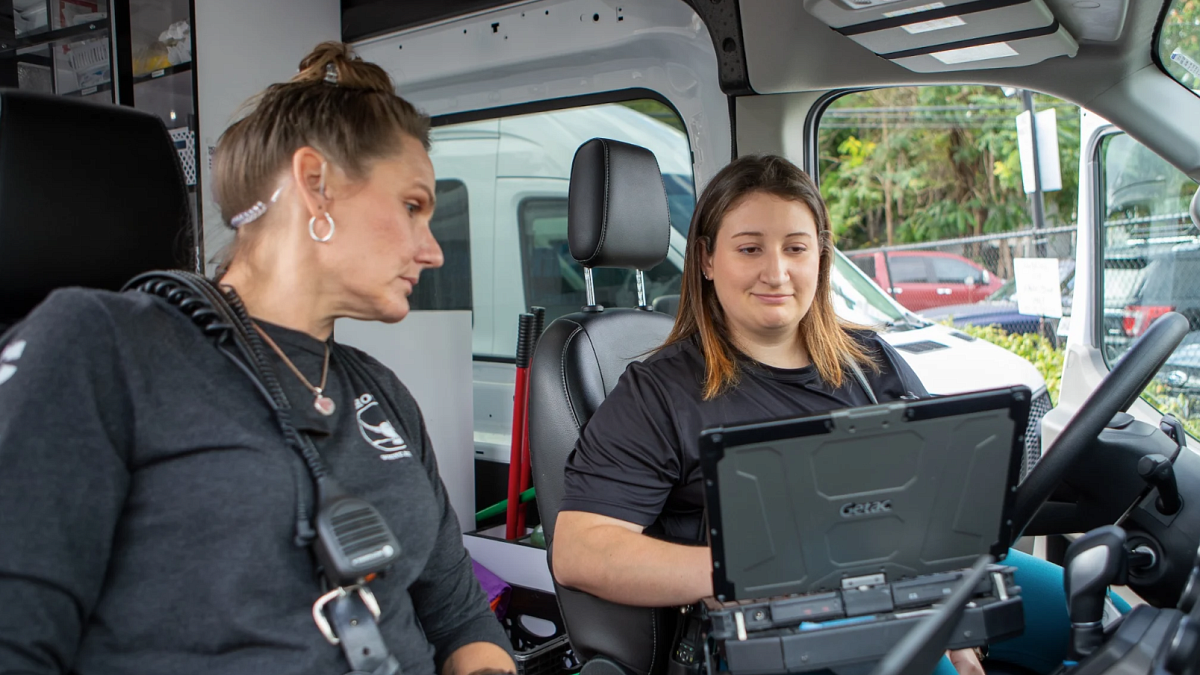
CAHOOTS, or Crisis Assistance Helping Out on the Streets, began serving Eugene in 1989, making it the longest-running mobile crisis response program in the U.S. Its two-person teams pair a crisis worker with a medic to respond to calls involving issues such as mental health crises, substance use and welfare checks, all of which are examples of 911 calls that do not require a traditional law enforcement response. The City of Eugene ceased funding for CAHOOTS in Eugene in 2025, but it does still operate in Springfield, a neighboring city.
The researchers say reliable measures can give communities better evidence for making decisions about how to allocate resources across their emergency response systems — information Herbert said would have been valuable for Eugene to have years earlier.
“As a former CAHOOTS worker who experienced the loss of the service in a very visceral way, and as a current advocate for the return of community response to the community of Eugene, I will fail to adequately express the importance of bringing receipts to this conversation,” said Laurel Lisovskis, LCSW, clinical director, crisis worker, Willamette Valley Crisis Care. “We see this academically rigorous, thoughtful work that these researchers have done to capture the weight of this loss as incredibly meaningful to our community to try and gain back a way to truly check on our neighbors and loved ones again.”
The data analysis research was done, in part, over the course of three terms in Rohlfs’ class, Data Science in Action. The study, “Quantifying CAHOOTS: Measuring a mobile crisis response program’s impact on police response through call diversion and prevention,” is available in Science Advances.
After the city of Eugene shut down CAHOOTS, Rohlfs continued the data analysis project with students and Burton, and posted a report, “After CAHOOTS: Service decline, shifting police attention, and a rising arrest rate.” It provides a quantitative analysis of 911 calls and responses in the aftermath of the closure, attempting to account for the roughly 235 calls per week that CAHOOTS had been handling.
While CAHOOTS’s time in Eugene has ended, the work of its teams and its data are supporting other community programs and their efforts to prove their impact.