
By Evan Ney, Student Writer, College of Arts and Sciences
—Hammad Ather, PhD, Computer Science
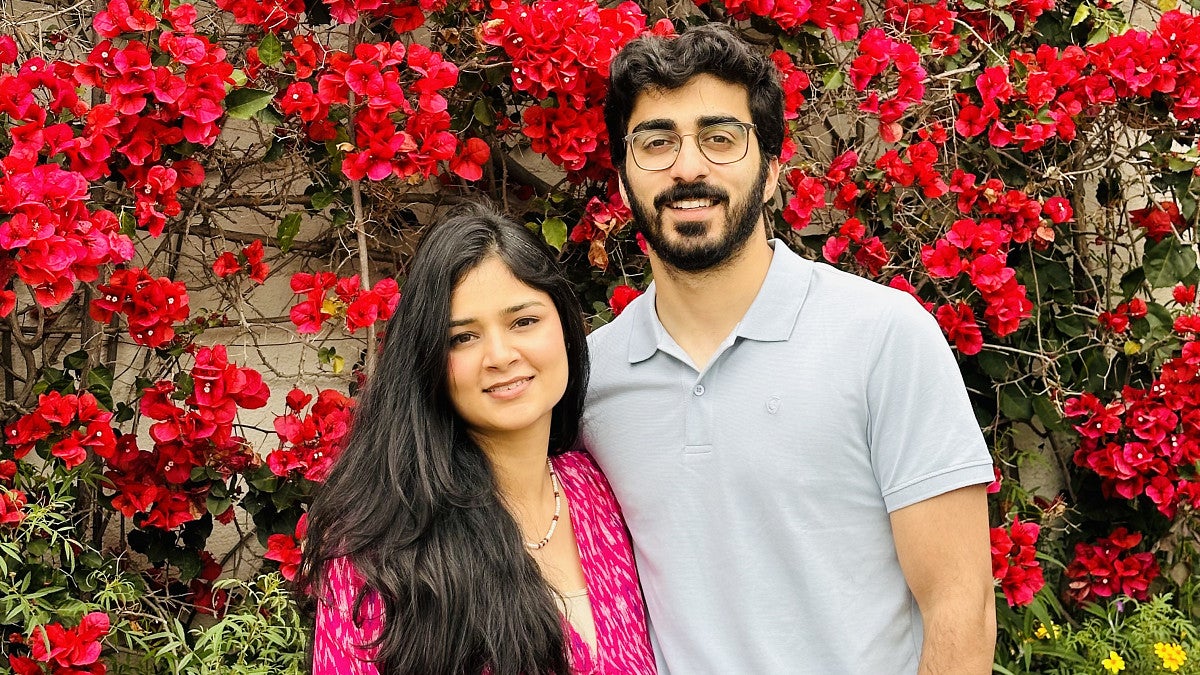
Opportunities to work at companies like the social media monolith Meta are significant accomplishments for one person, so it’s even more remarkable that Aliza Lisan and Hammad Ather both landed roles at the company at the conclusion of their graduate studies in the College of Arts and Sciences School of Computer and Data Sciences (SCDS).
Lisan and Ather are married and were both students in SCDS’s computer science doctorate program. They each grew up in Pakistan before they moved together to the U.S. for graduate school in CAS. Their story demonstrates the ways students can create opportunities in spaces like SCDS with exemplary faculty and strong connections to prestigious government and industry partners.
Finding a passion for computer science
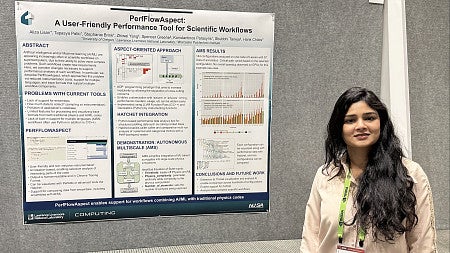
Aliza Lisan didn’t start out loving computer science.
“To be honest, I considered myself an anti-tech person in high school. My plan was to go into electrical engineering or something, but when that did not work out for me, my family encouraged me to look into computer science,” Lisan said. “I started liking computer science during my bachelor’s because I loved problem solving, and at the heart of it, coding is about solving a problem. That part really excites me still.”
Lisan grew up and earned her bachelor’s in Pakistan. When she graduated and found a job in the workforce, she was presented with a different type of problem to solve.
“I realized quickly that the work I was doing was not for me. I started looking into research and was drawn to the UO because of its reputation and collaborations with national labs,” Lisan said.
Lisan applied to SCDS’s doctoral program in computer science where she could earn both her master’s and doctorate. And it turned out research suited Lisan. After her first year at the UO, she had three offers from national labs to work over the summer. She worked at the Lawrence Livermore National Laboratory and returned there for the two following summers. She worked in high-performance computing, which became her area of study in SCDS.
The field of high-performance computing is emerging rapidly, particularly as the growth of AI has put increasingly extensive demands on energy resources. Lisan’s work largely centers around making these processes increasingly efficient to do more with less.
“My interests lie generally in the performance analysis part of high-performance computing. I try to pinpoint bottleneck issues so programs can run more efficiently, especially on expensive hardware and supercomputers,” said Lisan. “I like the scale of it. You hear about supercomputers and these large-scale projects, but not everyone gets a chance to work with them.”
After several summers working with the Lawrence Livermore National Laboratory, Lisan wanted to experience working in the industry, so she applied for an internship at Meta working in an area related to high-performance computing. She landed the job, then a return offer for a full-time role. Lisan plans to defend her dissertation towards the end of 2026 and then will become an employee of Meta.
Creating opportunity in high-performance computing
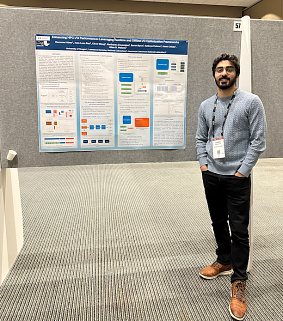
Unlike how Lisan’s interest in the field emerged over time, Ather’s interest in computer science was there from the start.
“I started working on computers back in the late 2000s and early 2010s. And I was always interested in math and sciences, so I took courses on coding early on,” Ather said. “I decided to pursue a degree in computer science, and once I finished my undergrad, I was interested in diving deep into research. That’s what led me to pursue a PhD.”
Ather applied to several schools in the U.S. at the encouragement of his advisor in Pakistan. Although he had options, Ather came to the UO because the university offered strong support for his research.
“UO was the school where I got the most generously funded PhD offer, which made a big difference for my ability to pursue a PhD,” Ather said.
At that point, he knew he wanted to do research, but it wasn’t until Ather arrived at the UO that his interest in high-performance computing emerged.
“I did a lot of systems work prior to coming to UO, but I had no idea about high-performance computing,” Ather said. “But because I had a systems background, Professor Boyana Norris agreed to work with me as a student and my interest developed quickly from there.”
Having the opportunity to work closely with professors led to major opportunities with Lawrence Berkeley Lab, Lawrence Livermore Lab and Fermilab, before Ather, too, began to pursue industry opportunities.
“I felt like I had a lot of freedom to explore different subjects at the UO. I had much more freedom to fail as well, which was missing from my prior experience,” Ather said.
His work with high-performance computing led to an internship, then a full-time job at Meta. His work centers around ensuring AI processes use resources as efficiently as possible.
“My PhD research involved optimizing storage systems for scientific applications, so at a high level it is pretty close to my work at Meta,” said Ather. “I think getting to work with professors like Allen Malony, Hank Childs, and Boyana Norris really helped me build the experience and connections I needed to get to where I am today.”
Shining together in computer science
Being together in undergrad in Pakistan, moving to the U.S. together and soon working at the same major company, Lisan and Ather’s individual achievements shine even brighter together.
“I’m glad it worked out this way. Obviously, luck plays its role, but I always like to say there is a lot of hard work and grit behind the opportunities we’ve been able to land together,” said Lisan.