
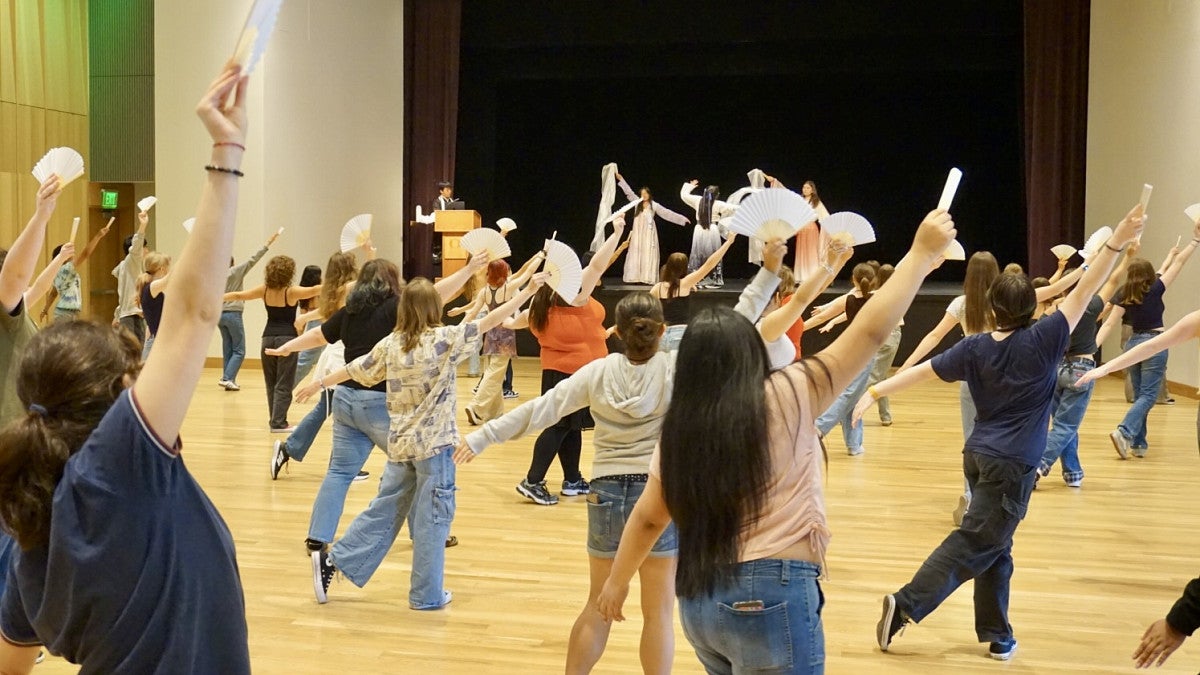
Over 675 Oregon high school students — from Pendleton to Medford — attended the 2026 Foreign Language & International Studies (FLIS) Day at the University of Oregon on May 1.
FLIS Day is an annual event presented by the Yamada Language Center in collaboration with the Schnitzer School of Global Studies and Languages in the College of Arts and Sciences. It’s a celebration and exploration of language and culture featuring more than 65 language and culture-related presentations, workshops and hands-on activities.
Michelle Hefner, administrative program assistant in the Yamada Language Center, has been coordinating FLIS Day for over 20 years and has been involved since 2000.
“It's something that's near and dear to me,” she said. “Being exposed to different languages and cultures changes the way you see the world.”
For the first time, Hefner’s twin sons attended. One looked forward to attending German presentations, while the other preferred Japanese.
She called it a “full circle” moment, as 16 years ago she planned FLIS Day while pregnant with them.
Showing the power of foreign language skills
At FLIS Day, students have opportunities to use their language skills and acquire new ones.
“The high school students are often surprised to see their heritage languages and cultures represented,” said Hefner. There were 17 different languages represented at FLIS Day this year.
She said a professor once asked her what would happen if only one student showed up for their presentation. “You could change the trajectory of how or what they're learning,” Hefner answered.
A few years ago, she pointed out, one high schooler heard the Arabic language and was hooked and came to the UO because of the Arabic program.
There is a place for everyone at FLIS Day
This year, the UO has recognized FLIS Day as a fully-fledged Youth Program , which means it must follow specific safety protocols such as mandatory reporting, criminal background checks, conduct requirements, supervision requirements, training, risk management and insurance registration, non-discrimination and emergency response planning.
Hefner put in extra time to bring the event up to compliance because she wants FLIS to be the best it can be. She is glad the event is getting “the recognition it deserves.”
First- and second-year college language students are encouraged to volunteer at FLIS, and there are never enough spots for everyone who wants to help out. Some come back every year for all four years of their college experience.
Maggie Ongbongan, a third-year cinema studies major and Chinese minor, is the volunteer coordinator. She also designs all the graphic media for FLIS.
Ongbongan became involved as a first-year performing with the Wushu Club , and last year, she performed with Kultura Pilipinas .
"It's really nice to see high school students get to learn about different cultures and different languages through FLIS Day,” she said.
New presentations shined this year from ASUO student groups Chinese Student Association , with a 2,000-year-old fan dance, and Duck Samba , with Rio-style Brazilian drumming.
The other popular large music and dance presentations were back, popular among the high schoolers for their interactive aspect.
K.Aire hosted a K-Pop workshop, Ahiru Daiko showcased Japanese drumming, the Wushu club practiced their full-contact sport derived from traditional Chinese martial arts, Kultura Pilipinas hosted traditional Filipino dance, and Hui ʻO Hawaiʻi gave hula lessons.
In honor of French culture, the UO language faculty presented new topics such as “Beyond Emily in Paris: Inside the Real France,” which debunked the image the Netflix show, “Emily in Paris,” depicts of berets, designer heels and constant sunshine.
The Papel Picado Demostración taught the intricate, hand-cut paper Mexican folk art. The Philippine Variety Game Shows presentation made students participants of popular game shows.
The Festival de Parantins presentation described the dramatic, competitive festival of the Amazon jungle. Zauberhaft shared the magical sounds from the long 19th century.
FLIS Day, said Hefner, “makes the UO a more friendly, less mysterious and, ultimately, a place of belonging when high schoolers consider college choices.”
Hefner said she wishes she had a similar opportunity in high school. “This opens up a lot of doors for students who may not have seen those doors as being able to be opened.”
— By Violet Ashley, College of Arts and Sciences