
Inside the human gut, billions of microbes compete and cooperate for survival. For many of them, access to a single nutrient — vitamin B12 — determines who thrives and who doesn’t.
That microscopic competition is the focus of research led by Romila Mascarenhas, a new assistant professor in the College of Arts and Sciences (CAS) Department of Chemistry and Biochemistry.
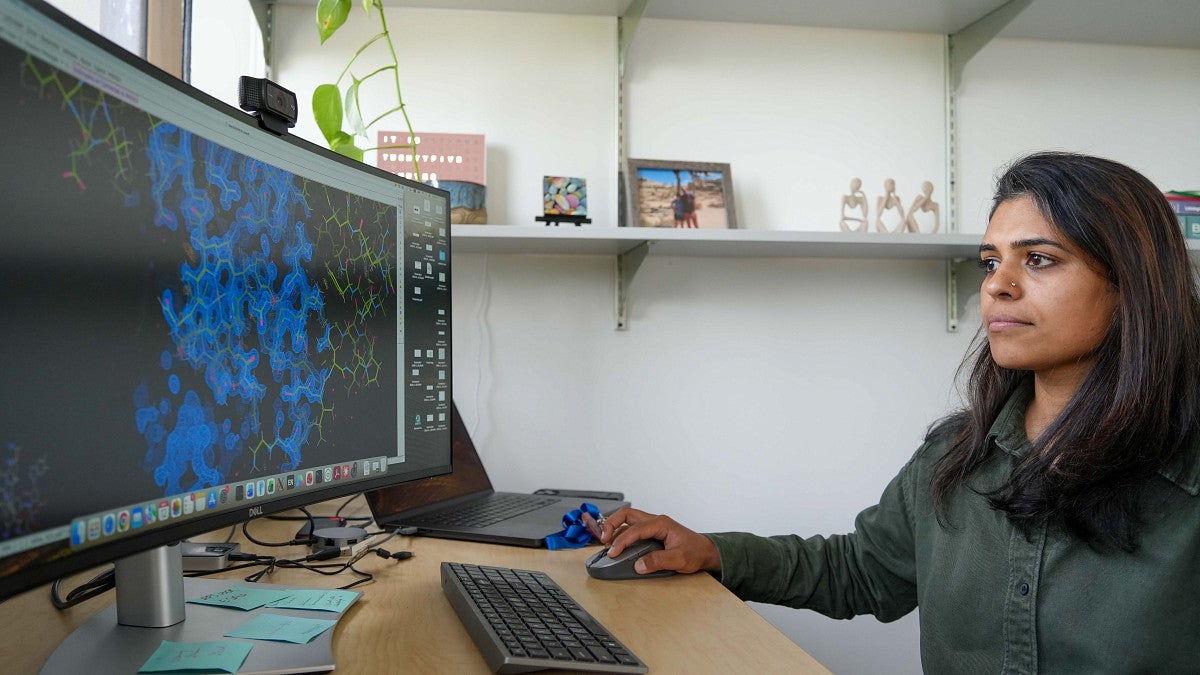
At CAS, Mascarenhas is starting a lab that investigates how gut bacteria recognize, transport and use vitamin B12, a molecule that plays a huge role in shaping microbial communities in the human gut. She anticipates her research will lead to collaboration with fellow CAS researchers across disciplines and attract a new generation of STEM students.
Following a molecule
Humans cannot produce vitamin B12 internally and must obtain it through diet, making us entirely dependent on external sources such as animal products, enriched cereals and supplements. Once the vitamin is in the body, it’s then transported through a complex pathway before it reaches the body’s resident B12-dependent enzymes that support the development and function of brain and nerve cells.
As a postdoctoral researcher at the University of Michigan, Mascarenhas studied the proteins responsible for guiding B12 through that pathway. Focusing her work on what are known as molecular chaperones, which ensure molecules reach their proper destination, she studied how B12 is transferred between molecular partners and delivered to their target enzymes.
This same level of molecular precision — guiding a molecule to its destination — is also the key to understanding the microbial landscape of our gut. About half of the human body’s gut microbiome cannot synthesize vitamin B12. Instead, many of these microbes depend on other members of the microbiome for their vitamin B12.
While our human cells focus on absorbing B12 for nerve and brain function, our gut bacteria are simultaneously competing for these same molecules to fuel their own survival. Understanding how different cells interact with B12 is what drives Mascarenhas’ research.
“We're interested in the mechanisms gut bacteria use to import and differentiate between cobalamin forms,” she said.
Vitamin B12 as a model for microbial interaction
For Mascarenhas, vitamin B12 is more than a nutrient. It’s a window into how microbes interact within the crowded human gut microbiome.
“If you think about strategies for understanding how microbes interact with each other within a microbiome, we think of vitamin B12 as a model nutrient,” Mascarenhas said.
The microbial makeup of the human gut plays a critical role in health, but it’s constantly shaped by the competition for micronutrient resources. Gut microbiome research suggests that imbalances can lead to various diseases including inflammatory bowel diseases, type 2 diabetes and even colorectal cancer. In the long run, Mascarenhas’s research could help scientists better understand how to reshape microbial communities in the gut to treat gut-related diseases.
From jersey to lab coat
Growing up in Bangalore, India, Mascarenhas originally imagined a very different career. Science interested her, but so did athletics, and for much of high school and college she focused on field hockey.
Medical school seemed like the natural next step. Until she discovered what’s possible with research.
At the end of her undergraduate studies, after her field hockey career wound down, she began exploring chemistry more seriously. She enrolled in a two-year master’s program, stepped into a research lab for the first time, and discovered structural biology and enzymology.
“That’s where I really got introduced to academic research,” she said.
That decision eventually took her from India to Loyola University Chicago for her doctorate, then to the University of Michigan for postdoctoral training. Along the way, vitamin B12 began to shape her scientific path.
Oregon’s legacy in structural biology
When considering faculty positions, Mascarenhas was drawn to CAS for both its research environment and its people.
Oregon also had long been on her radar because of its legacy in structural biology, a field that studies how the structure of biological molecules shapes their function. Researchers such as Brian Matthews and James Remington helped establish UO as a major center for protein crystallography, work that continues to influence the field today.
Trained as a structural biologist and chemist, she was excited by the opportunity to collaborate with microbiologists and researchers involved in the Institute of Molecular Biology (IMB) at UO. IMB’s interdisciplinary structure offered the kind of environment needed for research that spans chemistry, biochemistry and microbiology.
Beyond the research environment, Mascarenhas appreciated the collaborative culture she encountered during her campus visit. Relocating with a young child, she was also drawn to Eugene’s quality of life.
“I knew that I would have a perfect balance of work and life here,” she said.
Building a research lab culture
Mascarenhas joined the CAS faculty in 2024 and is now building her research group. As she establishes her lab, she is focused not only on scientific discovery but also on mentorship and collaboration.
“I’m a huge fan of collaborative research,” she said.
Rather than assigning isolated projects, she envisions a lab where students and researchers contribute different expertise toward shared scientific goals. Mentorship, she said, is one of the reasons she chose an academic career.
“I absolutely enjoy seeing my graduate students and undergraduate students when they have those ‘aha’ moments,” she said.
Beyond the research lab
Outside the lab, Mascarenhas enjoys running, something that Eugene makes easy, with trails and parks just steps from campus. She also spends time with her toddler and family.
From Bangalore to Chicago to Michigan and now Oregon, her path into science may not have been linear. But it has been guided by curiosity: about how molecules move, how microbes share resources and how biological structure shapes function.
— By Maria Soto Cuesta, College of Arts and Sciences