
In Alison Carter’s archaeology classroom, students learn that the past is not a fixed story waiting to be memorized. It is a puzzle built from fragments.
In Laurel Pfeifer-Meister’s biology lab, students learn that science is not about already knowing the answer. It is about struggling towards one together.
And in Colin Williamson’s cinema studies course, students learn film history by making it with their own hands, sometimes by recreating an 18th-century ghost show in two hours.
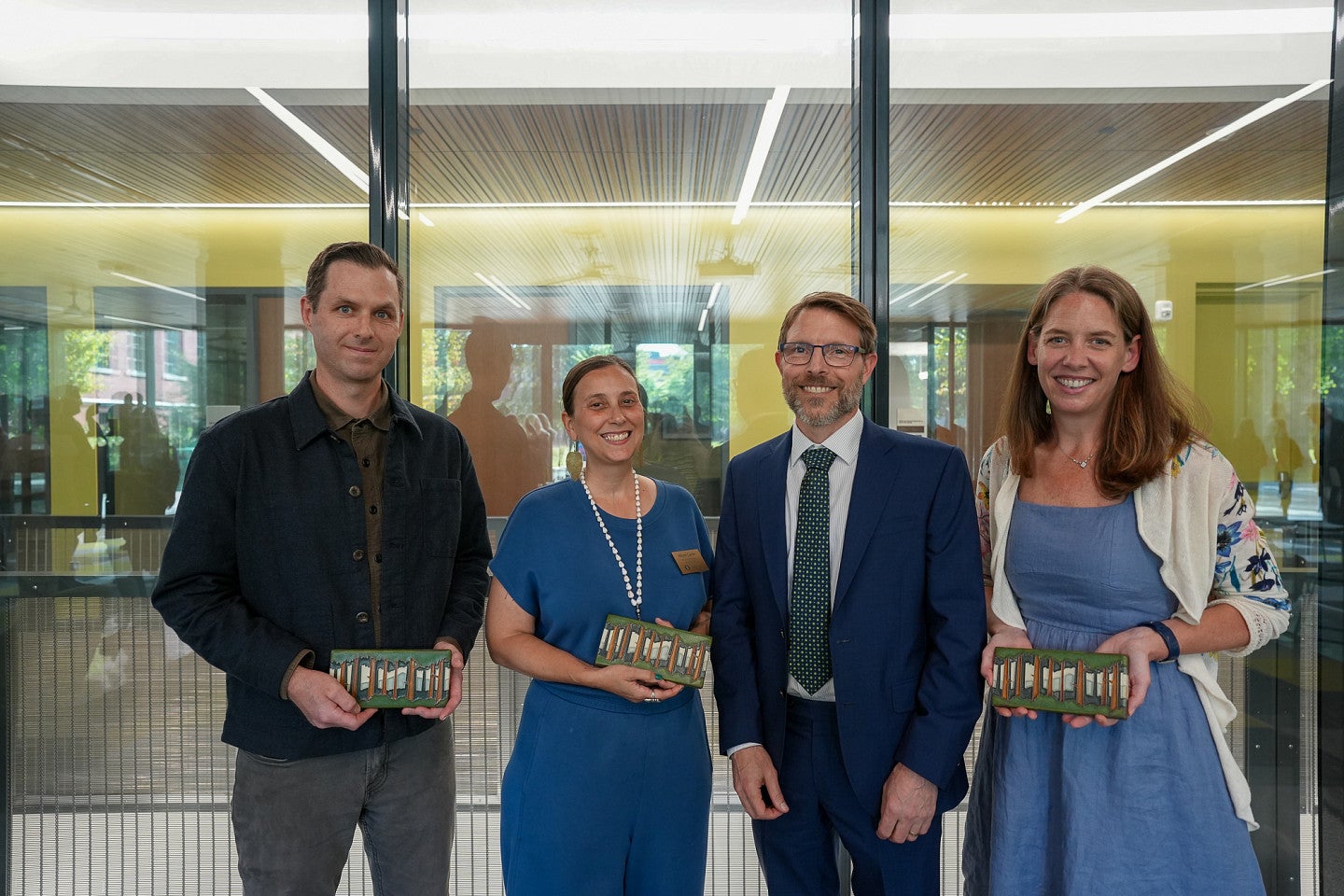
Alison Carter, associate professor in the Department of Anthropology, Laurel Pfeifer-Meister, associate teaching professor in the Department of Biology and Colin Williamson, assistant professor in the Department of Cinema Studies are this year’s College of Arts and Sciences (CAS) Tykeson Teaching Award recipients.
The annual awards are presented to one faculty member in each division of the University of Oregon’s largest college: humanities, natural sciences and social sciences. Established in 2015, the awards recognize instructors who demonstrate exceptional teaching and student outcomes.
This year’s recipients teach in different disciplines, but their classrooms all share a common thread: learning is active, personal and built through connection.
Digging into the evidence
Carter did not always think of herself as a natural-born teacher.
An anthropological archaeologist who specializes in Southeast Asia, Carter remembers being an introverted student, the kind who hoped not to be called on in class. Standing at the front of the classroom took practice.
“I don’t think I’m a natural teacher,” Carter said. “It’s something that I have learned and developed through the years.”
That perspective shapes the way she teaches now. In her archaeology courses, Carter builds support systems that help students find their way into unfamiliar material. In large classes, she uses guided notes, engagement technology such as iClickers and low-stakes review questions to keep students engaged. In smaller classes, she creates hands-on opportunities for students to work directly with archaeological materials.
For Carter, archaeology is exciting because it asks students to think carefully about evidence.
“Archaeology is a science,” Carter said. “But our record is very incomplete. And so that leaves a lot of gaps for interpretation.”
Josh Snodgrass, professor and head of the Department of Anthropology, nominated Carter for the award. In his nomination letter, he explained that Carter’s teaching fosters appreciation for human cultural diversity and helps students develop critical thinking skills through archaeological examples including pseudoscience, gender and interpretation.
For Carter, the hope is that students leave her classes still curious about the past.
“I hope they carry forward their interest in archaeology,” Carter said. “Even if they don’t remember all the details, that feeling of, ‘This is a really cool topic and I want to learn more,’ would carry forward with them.”
Learning happens during the struggle
At the beginning of each term, Pfeifer-Meister asks her students to write down their goals on sticky notes.
Some goals are academic. Others are personal. Over time, as students move through the three-term honors biology sequence together, the notes become part of a larger classroom culture: one built on growth, trust and community.
As the lead instructor for the Honors/Accelerated Biology 281, 282 and 283 laboratory sequence, Pfeifer-Meister teaches students across three terms, from protein biochemistry and metabolism to gene expression, ecology and evolution. That yearlong structure gives her something many instructors rarely get: time to build a community.
“One of the things that I feel extremely grateful for is that I teach a cohort of students from 281 all the way through 283,” Pfeifer-Meister said. “Building that community of students and building those friendships throughout the year is almost as important to me as the content is.”
Her teaching philosophy is built around a phrase she repeats often: learning happens during the struggle.
“Anytime we’re doing something a little bit more challenging or a little bit harder, I try to remind my students of that mantra,” Pfeifer-Meister said. “In life, the places where we grow the most are the places where we’re challenged the most.”
Her nomination letter, written by biology faculty David Garcia, Tory Herman, Brendan Bohannan and Matt Streisfeld, notes that she has taught more than 700 natural science undergraduates in the honors biology sequence over the past 10 academic years. The letter also highlights her work mentoring graduate employees and undergraduate learning assistants and creating a culture where students form lasting peer relationships.
For Pfeifer-Meister, that community is not separate from science. It is part of how science works.
“Science doesn’t happen in a vacuum,” she said. “It happens with a diversity of minds coming together and solving the next major challenge.”
When students leave her class, Pfeifer-Meister hopes they carry more than just the biology content. She hopes they carry confidence.
“Confidence that they know how to find answers,” she said. “That I’ve built that skill set of being able to critically think and determine how to approach problems.”
Making film history by hand
In Williamson’s classroom, film history can begin with a ghost show.
Williamson teaches film history, theory, animation, science fiction, and media aesthetics. But one of his most memorable teaching experiments comes from Hands-On Film History, a course he developed to help students experience early cinema as something material, collaborative and alive.
In one activity, students recreate a phantasmagoria, a ghostly performance popular from the late 1700s to early 1800s. Williamson divides the class into groups, gives each one part of the performance to research and build and asks them to create the show together in about two hours.
“They all have to work together to put on a ghost show in the historical way that it was done centuries ago,” Williamson said. “From nothing to everything.”
Students create sound design, visual effects, acting and staging. They problem-solve. They argue through ideas. They figure out who is good at what. And in the process, they learn that history is not only something to read about: it is something people actually made .
For Williamson, that kind of experience captures what he wants teaching to do.
“I want them to take away ways of thinking and ways of valuing the learning process,” Williamson said.
Peter Alilunas, associate professor in the Department of Cinema Studies, nominated Williamson for the award. In his nomination letter, Alilunas described Hands-On Film History as an innovative, grant-supported course that lets students “do” history through experimentation, making and collaborative inquiry.
Williamson said his goal is for students to leave with a different understanding of what learning can do.
“I want students to walk away with a sense that it doesn’t matter what you study,” Williamson said. “The way that you study can have long-term impacts on your life.”
Recognizing long-term impact
For Carter, Pfeifer-Meister and Williamson, teaching is not just about what happens during a lecture, lab or discussion. It is about what students carry with them after they leave.
A sharper eye for evidence. Confidence in the struggle. A renewed belief that their ideas matter.
That is what makes a class stay with someone. And that is what this year’s Tykeson Teaching Award recipients work to build every day.
— By Maria Soto Cuesta, College of Arts and Sciences
View a complete list of 2026 CAS Award Winners.