CAS News

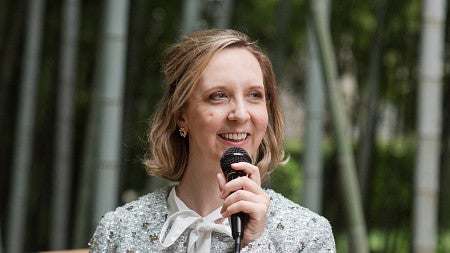
JAPANESE — Originally from Oregon, Meg Tsukamoto BA ’00 (Japanese) has spent the last 25 years living and working in Japan. She is a professional emcee, serving as both interpreter and facilitator for large events such as wedding receptions, a niche she found after struggling to find a bilingual emcee for her own wedding in Japan.
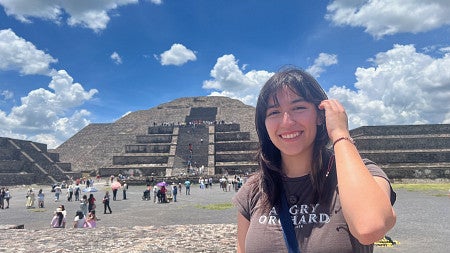
GENERAL SOCIAL SCIENCES, SPANISH — Some students study abroad for a chance to learn a new language, to immerse themselves in a different culture, to gain work experience or for personal growth. Junior Jolie chose Querétaro because she wanted to gain a better understanding of Spanish and the Mexican culture.
THEATRE ARTS — When disaster strikes in a play, audiences get to watch from the safety of their seats as characters wrestle with what comes next, always hoping for a happy ending. During its 2026-27 season, the University of Oregon’s University Theatre is producing four shows that promise to take audiences on a cathartic and rewarding journey, beginning in November with "Noises Off."
PSYCHOLOGY — For Mara Sargent ’14 (psychology) the beauty of campus, the community and the atmosphere atmosphere that reminded her of home in Berkeley, California, and all played a significant part in developing her professional career.
HISTORY - College of Arts and Sciences history professor Vera Keller's 2024 book, “Curating the Enlightenment: Johann Daniel Major and the Experimental Century" received the prestigious Pfizer Award from the History of Science Society recognizing an outstanding book dealing with the history of science.
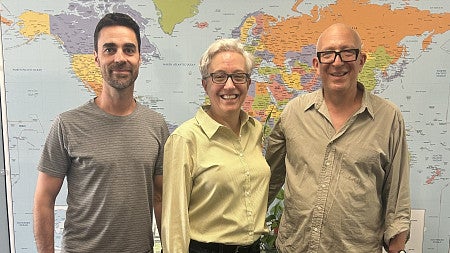
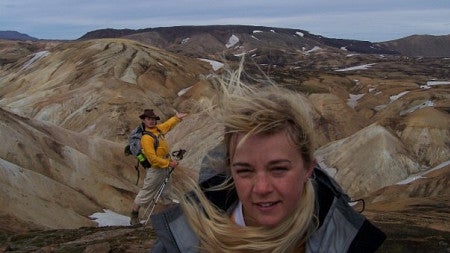
COMPUTER SCIENCE, EARTH SCIENCES — Brittany Erickson, associate professor of computer science and earth sciences, and Reza Rejaie, professor of computer science, were awarded Fulbrights to conduct research and act as cultural ambassadors while abroad in Iceland and Finland, respectively.
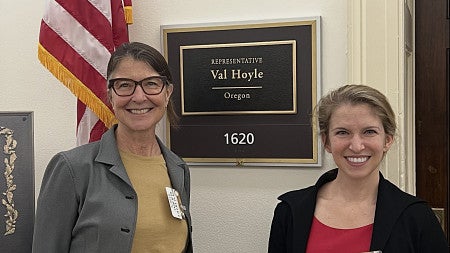
HUMANITIES — More than a year after the National Endowment for the Humanities (NEH) canceled approximately $175 million in grants nationwide, two College of Arts and Sciences professors are feeling optimistic about the future of the humanities after two days in Washington, D.C., advocating for the humanities.
PHYSICS - A research team led by College of Arts and Sciences physicist Stephanie Majewski received a $662,000 phase one grant from the U.S. Department of Energy (DOE) as part of the Genesis Mission, a national initiative to bring together universities, DOE national labs, and industry together to integrate artificial intelligence into science, energy, and national security. Majewski will collaborate with collaborators at Brown University and Brookhaven National Laboratory to use AI to save time and computing costs for experiments at CERN’s Large Hadron Collider (LHC), the world’s most famous particle accelerator.
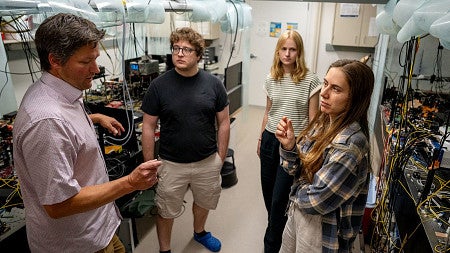
PHYSICS - In June, Professor Brian Smith’s team was awarded a two-year, $4 million grant from the National Science Foundation to develop a prototype quantum network on the UO campus. “We have our work cut out for us, but our research will transform communications, sensors and computers,” said Smith, director of the Oregon Center for Optical, Molecular and Quantum Science.
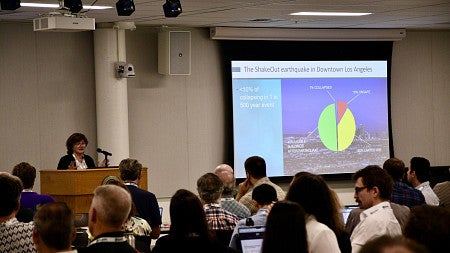
EARTH SCIENCES - On June 25-26, more than 140 earthquake scientists, emergency managers, Tribal representatives, engineers, utility operators, and community leaders gathered at the University of Oregon’s Portland campus to tackle a common question that spreads across their fields: How can science better support decisions before, during, and after the next major Cascadia earthquake?
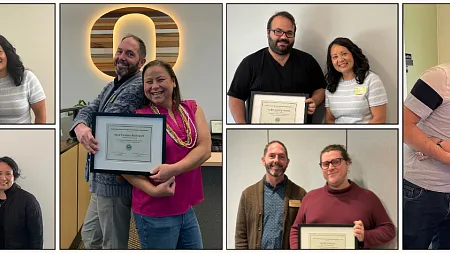
LINGUISTICS - Strong mentorship helps graduate students develop as scholars while honoring the unique experiences, identities, and goals they bring to their work. Mentors help students identify their strengths, navigate challenges, and imagine new possibilities. Linguistics Assistant Professor Guillem Belmar-Viernes and Jessica Cronce (College of Education) are winners of the Excellence in Mentorship Award for Faculty Mentors, provide mentorship that recognizes the whole student.
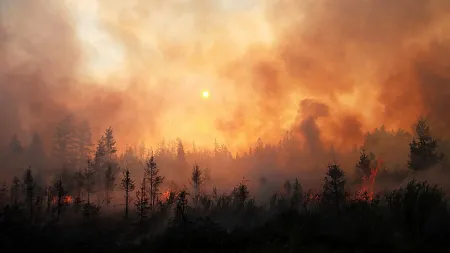
EARTH SCIENCES, ENVIRONMENTAL STUDIES - In recent years, wildfires have increasingly affected Oregon and much of western North America. Due to many factors including climate change and land management practices, wildfires are intensifying and becoming more common both within and beyond our region. At the University of Oregon, researchers across disciplines are turning wildfire science into practical tools, strategies, and partnerships that help communities prepare, respond and adapt.
EARTH SCIENCES - Hilly and mountainous landscapes have a much greater ability to store carbon in the soil than previously thought, according to a new study co-led by College of Arts and Sciences researchers. “There was a misconception that mountainous areas would not hold much carbon because they’re so rapidly eroding and there’s not much soil,” said Josh Roering, an earth scientist at the UO.
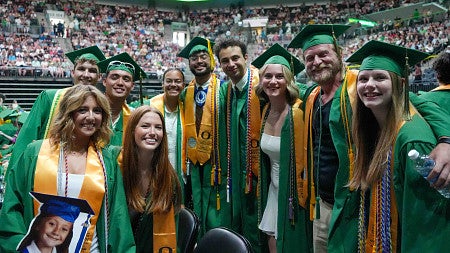
Highlights from the June 15 University of Oregon College of Arts and Sciences commencement ceremonies at Autzen Stadium and Matthew Knight Arena.
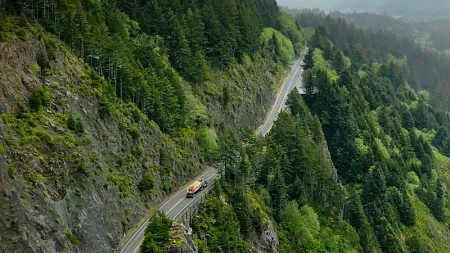
GEOGRAPHY - College of Arts and Sciences researcher James Lamping is leading a comprehensive mapping effort that sheds light on the location, makeup and conservation status of old-growth forests across the region. Forty percent of mature and old growth forests in the study area are in places that lack permanent legislative protection, which also store the most carbon in the study area, according to his data.