Natural Sciences News

The graduating class of 2025 represents the diversity of thought that is a hallmark of a liberal arts education. With 2,936 students graduating with a degree—including bachelor’s, master’s and PhD levels—this year’s group of CAS graduates is about 13% larger than class of 2024. Equipped with a liberal arts degree, these three graduating seniors are prepared to forge their own path.
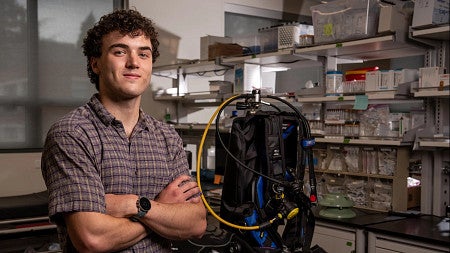
CHEMISTRY AND BIOCHEMISTRY, PHYSICS - One mathematical equation can open a world of possibilities. And that's what this College of Arts and Sciences graduate student is finding. Jesse Hall, a physics doctoral candidate, worked with theoretical physical chemistry professor Marina Guenza to develop the new model that could help advance the development of new drugs and sustainable materials.
From teachers so beloved they’ve built a cult-like following to innovative researchers who are raking in patents, meet the recipients of the 2025 CAS Awards.
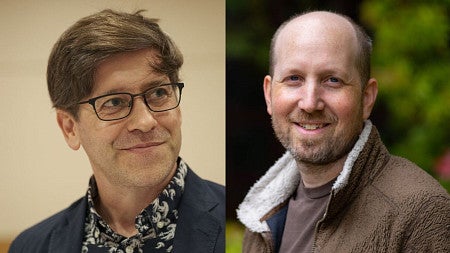
MATHEMATICS, CHEMISTRY AND BIOCHEMISTRY - Professors Ben Elias of the Mathematics Department and Mike Pluth of the Chemistry and Biochemistry Department received the prestigious CAS Collegiate Faculty Award, the highest honor the College of Arts and Sciences awards to active tenure-track faculty members. The award recognizes faculty who have demonstrated exceptional leadership and made outstanding contributions to their field and the broader UO community.
HISTORY, THEATRE ARTS, PSYCHOLOGY - Three University of Oregon professors in the College of Arts and Sciences have received teaching awards for their excellence in the classroom. The 2025 awardees include Associate Professor Jeanette deJong in the Department of Theatre Arts, Senior Instructor II Alexander Dracobly in the Department of History and Associate Professor Sara Weston in the Department of Psychology. 
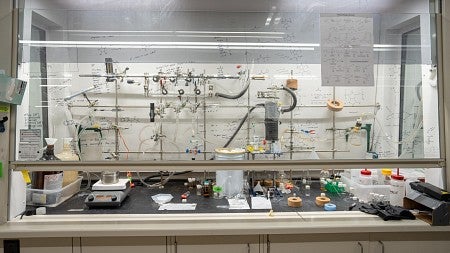
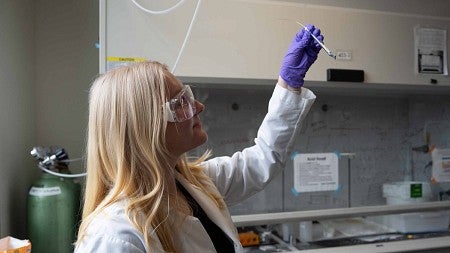
CHEMISTRY AND BIOCHEMISTRY - As the effects of climate change become increasingly apparent, scientists around the globe are racing the clock to mitigate its impact. Although time is running out to meet the original goal outlined in the Paris Agreement—achieve net-zero carbon emissions by 2050 and limit global warming to 1.5 degrees Celsius—CAS chemists are hard at work tackling the problem from a variety of angles.
NEUROSCIENCE - Valerie Owusu-Hienno, a third-year College of Arts and Sciences student who aspires to be a physician, researcher, and global health advocate, has been named a Goldwater Scholar. It's a nationally prestigious award for undergraduates conducting research in the natural sciences, engineering, and mathematics.
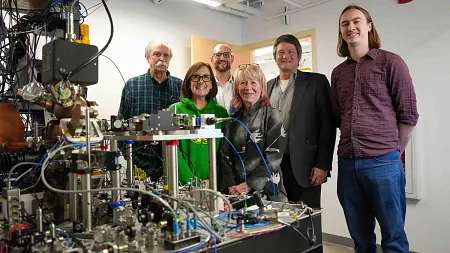
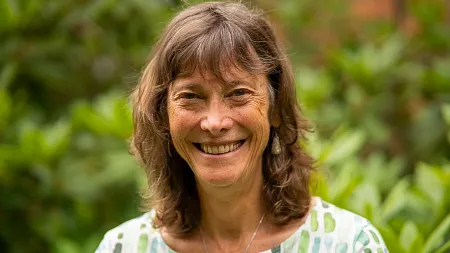
CHEMISTRY AND BIOCHEMISTRY - After serving four years as undersecretary for science and innovation at the U.S. Department of Energy, College of Arts and Sciences chemistry professor Geraldine “Geri” Richmond is back at the University of Oregon. Richmond was one of the top science officers in the federal government, overseeing billions of dollars in research spending on some of the nation’s highest science priorities, including quantum computing, clean energy and national security.
CHEMISTRY AND BIOCHEMISTRY, ANTHROPOLOGY - Two University of Oregon faculty members have been named 2024 fellows by the American Association for the Advancement of Science (AAAS), joining 471 other newly elected members whose work has distinguished them in the science community and beyond. This year’s fellows and their areas of research are Darren Johnson, chemistry and biochemistry, and Stephen Frost, anthropology.
PSYCHOLOGY - Dare Baldwin, a psychology professor in the College of Arts and Sciences, is working with undergraduate researchers to better understand how people behave during an earthquake. The research team will bring in families to campus to have them participate in an earthquake simulation. Observing how long it takes families to mobilize and how their behavior unfolds will help researchers determine the best way to educate people to take appropriate protective action.
The College of Arts and Sciences faculty are engaged in a multitude of research projects across our three divisions: Natural Sciences, Social Sciences and Humanities. Within our college’s more than 50 departments and programs, millions of dollars in grant funding are at work uncovering answers to some of the world’s most pressing questions. Here’s a look at the funded projects our researchers investigated in the 2023-2024 academic year.
Faculty in the College of Arts and Sciences are on the frontline of addressing the world's most pressing issues, including AI, Alzheimer's, ice sheet loss in Greenland—and more. These are big problems, and our faculty members are relying on millions of dollars in grant funding to explore solutions for a better tomorrow. Read more in the 2023-24 annual report, out now.
HUMAN PHYSIOLOGY, NEUROSCIENCE - Using functional MRI brain imaging, or fMRI, University of Oregon researchers have unraveled some of the neural circuitry behind basic human actions. Their insights, described in a paper published in the journal eNeuro, can be used to improve the design of brain-computer interface technologies, including brain-controlled prosthetic arms that aim to restore movement in people who have lost it.
DATA SCIENCE - In Applied Data Science for Social Justice, a new course developed by Associate Professor Rori Rohlfs in the School of Computer and Data Sciences, students partnered with the Eugene-based CAHOOTS program to help its organizers sift through data they’ve collected from thousands of dispatch calls to glean insights on how they can improve their services. CAHOOTS works to help people with mental health struggles.
PSYCHOLOGY - Since earning his PhD from the Department of Psychology in 1996 under the joint supervision of professors emeriti Douglas Hintzman and Michael Posner, Daniel Levitin has become one of the most prominent figures in cognitive science. Levitin visited the Eugene campus to donate his papers to the UO Libraries’ Special Collections and University Archives, Levitin delivered a guest lecture about his new book to students in a course on cognitive psychology taught by Nicole Dudukovic, director of the UO’s Neuroscience Program.