
Getting research published in an academic journal is a necessary step for professors and grad students. But Jennifer Pfeifer doesn’t think that's enough.
As the associate dean of research and scholarship in the College of Arts and Sciences (CAS), Pfeifer advocates for research to be incorporated into the classroom, shared across disciplines and shared far beyond the halls of academia.
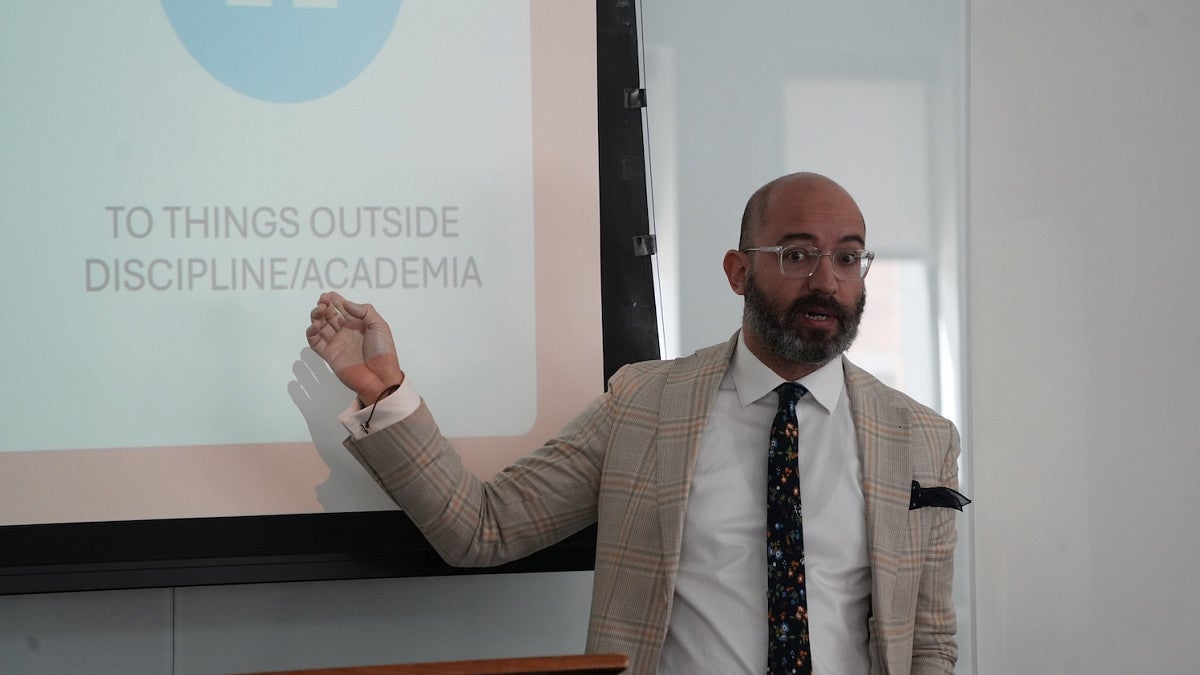
When the Office of the Vice President for Research and Innovation recently hosted a Week of Research and Innovation, Pfeifer organized a panel session as part of the week’s events to showcase the breadth of the social impact CAS researchers have.
“It’s important to highlight why research matters and to think broadly about what it means to be impactful,” said Pfeifer. “Across the college we have extraordinary examples of work that represent societal impact. It's very broad. It's very inclusive.”
For the panel, “CAS Social Impact Forum: Increasing the Social Impact of Research,” Pfeifer invited four CAS professors to share the diverse methods they’ve used in their work.
Using research to impact communities
Sarah Wald , associate professor in environmental studies, focuses on environmental justice in Asian American and Latinx literature and culture in the 20th and 21st century. In her work, she partners with community organizations to bring research to the classroom.
For example, she partners with Food for Lane County and makes it part of her 200-student Intro to Environmental Humanities class. She said students have given between 7,000 and 8,000 hours of their volunteer labor that is also directly connected to their learning and writing.
Rori Rohlfs , associate professor in data science, offered another example of classroom and community partnership. She and her students used data analysis to help a non-profit demonstrate its value through data.
The project started as an experiential learning project in her Applied Data Science for Social Justice class. She and the students worked closely with a community organization, CAHOOTS, and its partners to gather and analyze the data that would help them prove their impact on the community and city services.
The results generated media attention and opportunities to impact social policy at the city level. While their data analysis didn’t stop the City of Eugene from defunding CAHOOTS, Rohlfs points to the silver lining.
“I'm teaching the class for a third time now, and now we have data that includes what happened after CAHOOTS stopped service, which allows us to answer a bunch of questions that were previously not answerable,” she said.
Using research to impact an industry
Ann Swindells Professor of Clinical Psychology Nick Allen was frustrated with the lack of impact his research was having on the clinical treatment side of mental health.
“We did clinical trials. We published them in good journals. And then I couldn't give it away,” he said.
His solution was to start a mental health solutions company, Ksana, which helps mental health providers improve mental health outcomes. He is the CEO.
Allen has found this path to be the most effective for reaching mental health providers, although he did admit it’s challenging to be in academia and industry at the same time.
“Any kind of change, you're pushing against the grain. And so you've got to have that strong sense of mission about what you're doing because it is the thing that keeps you going when things are hard, and it'll be hard quite a bit.”
The impact of engaging in public scholarship
Ramón Alvarado, associate professor in philosophy, studies computation and artificial intelligence. His practice is to bring philosophical questions and his research to a variety of groups, some inside academia, but a lot in the community. He regularly makes presentations to community groups such as churches and libraries.
“If I just stay around with philosophers, we might have a breakthrough by the next century, especially when we're talking about artificial intelligence,” he said, referencing philosophers’ tendency to debate for centuries. “Presentations in the community are a way for me to engage with other disciplines.”
Recognition for social impact practices
To recognize researchers who think more broadly about how their research can have an impact, CAS leadership has developed a new award: Social Impact and Research and Scholarship Award.
“So much of this work has already been happening. We just aren't always consistent at naming or rewarding it. And so it’s one of our current strategic priorities to change that,” said Pfeifer. “It's our goal to make social impact more visible and more valued without narrowing what it looks like or prescribing a very particular way to have social impact.”
In CAS, research doesn’t end when it’s published, Pfeifer acknowledges. It’s shared in classrooms, communities and conversations so it can have the most impact.
— By Jenny Brooks, CAS Communications