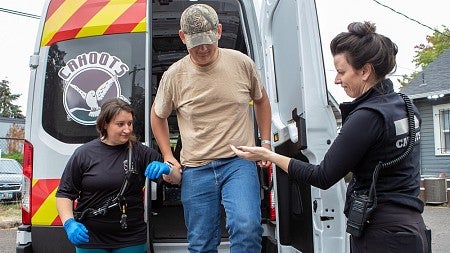
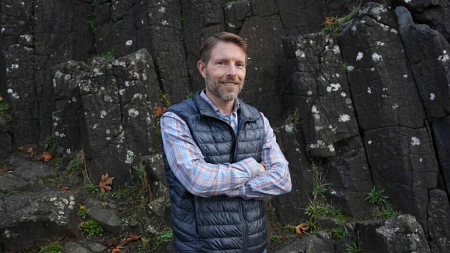
DATA SCIENCE - In Applied Data Science for Social Justice, a new course developed by Associate Professor Rori Rohlfs in the School of Computer and Data Sciences, students partnered with the Eugene-based CAHOOTS program to help its organizers sift through data they’ve collected from thousands of dispatch calls to glean insights on how they can improve their services. CAHOOTS works to help people with mental health struggles.
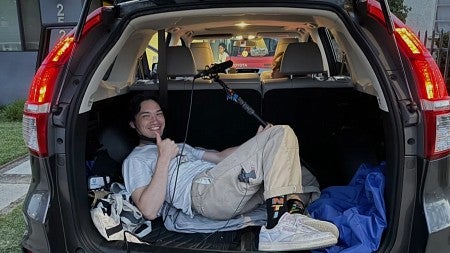
CINEMA STUDIES - It was a cinema studies major’s dream come true: Four CAS undergrads traveled to Los Angeles to work on the set of Professor Ernesto Javier Martínez’s upcoming feature film. From dressing a background set to operating a boom mic in the trunk of a car, they share what it’s really like behind the scenes of a movie. Read more in the January 2025 issue of CAS Connection.
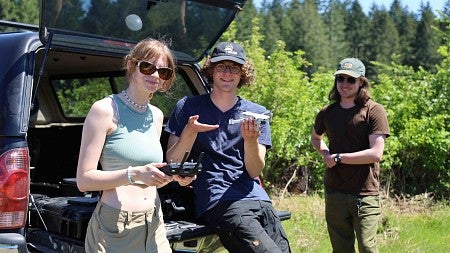
GEOGRAPHY - Look! Up in the sky! It’s a bird. It’s a plane—it’s students using drones for mapping! High-flying unmanned aerial vehicles, commonly known as drones, are increasingly used to map and analyze large areas, especially in a world impacted by climate change. To prepare students for mapping-related careers, the College of Arts and Sciences’ Department of Geography offers a Mapping with Drones course during the spring term.
PHYSICS - Could life exist elsewhere in the Milky Way galaxy? A group of College of Arts and Sciences undergraduate planet hunters are helping NASA discover unknown worlds beyond our solar system. Read more in the December sci-fi issue of CAS Connection.
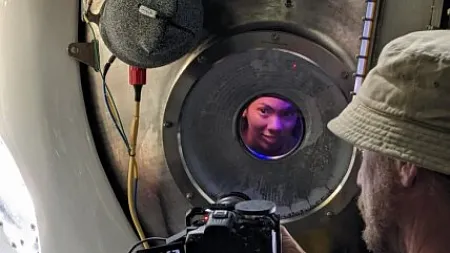
MARINE BIOLOGY - Marine biology students searched the Atlantic Ocean for rare organisms that thrive without sunlight. An upcoming IMAX film will document their journey—and, they hope, inspire a new generation of women scientists.
Four months later and 62 miles away, University of Oregon student Marcus Chaknova was sailing around the Lau Basin with marine biologists from the College of Arts and Sciences’ Oregon Institute of Marine Biology and other universities, looking for snails and other organisms at hydrothermal vents—deep-sea hot springs where seawater and magma combine and enable a rare set of organisms to thrive without any sunlight.