Experiential Learning | Research & Innovation | Community Impact | Career Preparation | Teaching Excellence | 21st Century Liberal Arts | Building Community | Good Vibes | CAS Spotlights | All Stories | Past Issues
Research & Innovation
Celebrate Research Progress
Researchers in the College of Arts and Sciences secured $83 million in sponsored grants to fund 199 research projects across the three divisions: Humanities, Natural Sciences, and Social Sciences. This year’s annual report provides a glimpse into the curious minds of researchers and their work.
Professor is cracking the cosmos
Eric Torrence, physics professor, will spend 18 months monitoring the mysteries of our universe.
CAS gives antibiotics a boost
Researchers have tested a new combination drug therapy that could dismantle difficult-to-treat bacteria.
Ballot Measures Are Booming
Some states are seeing an increase in ballot measures as voters act, in a way, as lawmakers.
AI Tracks Endangered Bees
Biologist Lauren Ponisio and collaborators are using the technology in place of lethal capture.
Fascinated with Fractals
Physics Professor Richard Taylor blends art and science to create award-winning nature-inspired designs for indoor environments.
Home Is Where the Hearth Is
New book by food studies and global studies associate professor Stephen Wooten explores how women in Mali build community through food
Exploring Volcanic Fallout
A student’s discovery of ash from an underwater volcano will shape scientific research for years to come.
The Show Must Go On
A groundbreaking digital humanities project brings theater history to the public, despite federal funding cuts.
Life as a Migrant Worker
A historian’s research on temporary migrant work policies is one of many projects around the country to lose NEH funding.
Green Chemistry for a Green Future
As the deadline to curb carbon emissions nears, CAS chemists are hard at work developing a new generation of sustainable tech.
The Cost of a Changing Climate
How will Oregonians feel the crunch from climate change? These economists dug through the data.
On the Origins of Research Universities
Ever wonder how research universities like UO evolved? It all comes down to one man, according to history prof Vera Keller.
What's in a (Scientific) Name?
A PhD candidate’s award-winning essay reveals the role of women in 17th-century scientific research—and what it sometimes cost them.
Before the Shaking Starts
An earthquake early-warning alert can buy you life-saving seconds to drop and take cover—and CAS researchers want to help you make the most of them.
A Journey to Jupiter’s Moon
Is there a habitable environment beneath the moon Europa’s icy crust? CAS Professor Carol Paty is helping NASA find out.
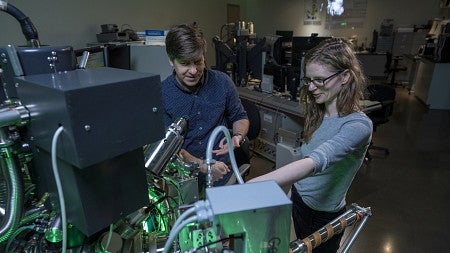
Tiny Invisible Universes
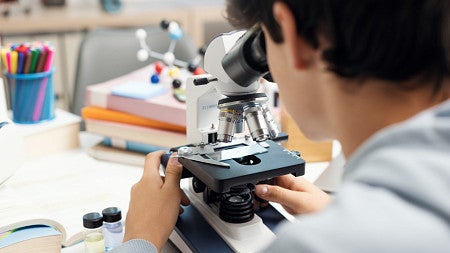
In UO’s materials characterization labs, researchers are pushing the boundaries of what can be observed through a microscope.
‘Fighting Mad’ Tackles Reproductive Justice
The overturning of the nearly 50-year-old constitutional right to abortion in the US sparked a wave of responses across the nation. Explore the impact of this momentous decision through a collection of voices and perspectives in Sociology Associate Professor Krystale Littlejohn’s latest book.
A Supercomputer Scavenger Hunt for Energy Storage
The discovery of a material that can efficiently store and deliver electrochemical energy could be a game changer in the transition to clean power. Christopher Hendon and his chemistry research group are searching for it—not in the ground, but in the circuits of a supercomputer.
Understanding Imperiled Earth' Digs into Climate History
When Paris’s Notre Dame burned in 2019, experts quickly realized there weren’t enough large trees in Europe to accurately reconstruct the cathedral’s roof.That was the moment anthropology alum Todd Braje realized how humanity’s history is connected to climate change.
Pushing Human Limits: Meet Brad Wilkins
Working with some of the world’s top marathon runners at Nike, human physiologist Brad Wilkins led the charge to break the 2-hour marathon barrier—an attempt that led to the National Geographic documentary Breaking2. Now head of the new Oregon Performance Research Laboratory, he’s using science to help athletes push past their perceived limitations and achieve new heights.
‘Pacific Arts Aotearoa’ Celebrates New Zealand History
After a three-year labor of love and a long-standing desire to give a voice to Pacific artists, Associate Professor Lana Lopesi offers a mosaic of narratives that delve into the complex and unique history of Aotearoa New Zealand in Pacific Arts Aotearoa.
More than just a compilation, the book serves as a celebration of resilience and a testament to cultural diversity while calling for more inclusivity of Pacific voices in art and literature.
How 50 Years of Hip Hop Have Shaped the English Language
Over the past 50 years, hip hop has grown from a popular music genre to a cultural revolution that spans the globe, affecting everything from fashion to language. Linguistics Professor Rachel Weissler explores the profound influence of hip hop on the English language.
‘The Sisterhood’ Celebrates Black Feminist Writing
In 2004, Courtney Thorsson, an English associate professor in the College of Arts and Sciences, first learned about a photo of a group of Black women that would take her nearly 20 years to investigate. Gathered in a prewar New York apartment, the black-and-white photo included writers Toni Morrison, June Jordan and Alice Walker. Thorsson’s new book, The Sisterhood: How a Network of Black Women Writers Changed American Culture, brings together documents, close readings and interviews to show readers the transformational activities that occurred at those gatherings.
'Red Leviathan' Explores the History of Soviet Whaling
While conducting research on the Russian fur trade, Department of History Professor Ryan Tucker Jones kept encountering whales, both in literature and in real life. Upon learning that the Soviet Union had conducted a massive illegal whaling campaign in the 20th century, he knew he had something important to write about. His resulting book, Red Leviathan: The Secret History of Soviet Whaling, was shortlisted in June for the prestigious Pushkin House Book Prize and won the John Lyman Book Award from the North American Society for Oceanic History in 2022.