CAS News

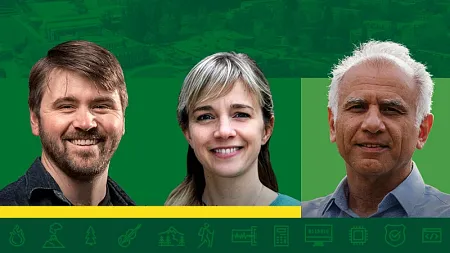
LINGUISTICS, EALL — Three faculty members from the College of Arts and Sciences were inducted as Fellows into the premiere linguistics organization and a doctoral student receive an exclusive award for her research paper.
Throughout the week of April 6–10, 2026, the Office of the Vice President for Research and Innovation, along with campus partners, will host a series of events open to faculty, students, postdoctoral scholars, and staff. The event will feature researchers throughout the College of Arts and Sciences.
ANTHROPOLOGY - Theresa Gildner’s research in the Amazon as a doctoral student in anthropology led to publications and experience in conducting ethical field research. She continues that work as a Washington University faculty member.
COMPUTER SCIENCE - Over the past few terms, computer science professors Hank Childs and Aye Thuzar have been working on reworking the entry level computer science class, “Fluency with Information Technology,” to incorporate AI-assisted programming.
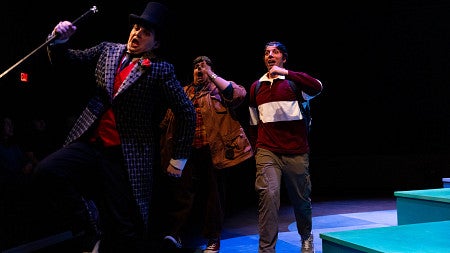
THEATRE ARTS - The Robinson Theatre is reopening this February with University Theatre’s winter production of Shakespeare’s “Much Ado About Nothing.” The reopening brings University Theatre’s largest performance space back into rotation, marking an important step forward for student training, production capacity and community engagement.
THEATRE ARTS — Love, mischief and mistaken intentions take center stage this winter as University Theatre presents “Much Ado About Nothing” by William Shakespeare. Directed by Jerry Ferraccio, the production marks the grand reopening of Robinson Theatre and runs Feb. 13, 14, 20, 21, 22, 27, 28 and March 1.
PHYSICS -At the University of Oregon’s Institute for Fundamental Science, a growing number of faculty have earned prestigious honors from the National Science Foundation and the U.S. Department of Energy, which signal both individual excellence and the institute’s positive research trajectory. The most recent winner is CAS physicist Tien-Tien Yu, who received an NSF CAREER Award followed by the Presidential Early Career Award for Scientists and Engineers.
ENGLISH - CAS undergraduate student Sarah Twiggs’ short story takes the perspective of an ant to win flash fiction contest. "The story was also inspired by the work I’ve been doing with posthumanism in a few of my classes," Twiggs said. "I find it really interesting to de-center the human perspective and consider new ways of thinking and being."
SPANISH - College of Arts and Sciences alum Brandon Rigby enjoyed studying Spanish, but it wasn’t until a professor suggested he major in it that he dove in. With multiple overseas assignments under his belt, he is now a global diplomat for the U.S. Department of State.
PHYSICS, CHEMISTRY, BIOCHEMISTRY, BIOLOGY — A new cutting-edge major in the University of Oregon College of Arts and Sciences prepares students to drive technological change through high-demand careers in fields such as semiconductor manufacturing, energy and sustainable materials development.
PHYSICS - A supermassive black hole with a case of cosmic indigestion has been burping out the remains of a shredded star for four years — and it’s still going strong, new research led by University of Oregon College of Arts and Sciences astrophysicist Yvette Cendes. Cendes and her team published findings about this one-of-kind black hole in the Feb. 5 issue of Astrophysical Journal Astrophysicists.
BIOLOGY - Marine biologist Alan Shanks has a simple trap that allows him to predict the amount of Dungeness crab will be available for fisherfolk. For the past 25 years, Shanks has compared the yields of the winter commercial catch to the baby crabs his water-jug trap collects each summer.
PHYSICS - About 15 feet below 13th Avenue, scientists in the Center for Advanced Material Characterization in Oregon (CAMCOR) are using a brand-new scanning transmission electron microscope (S/TEM) to enable cutting-edge research at the atomic scale. You’d never know that the busy University of Oregon street is nearby; the facility was built into bedrock to prevent vibrations that could affect delicate instrumentation.
SOCIOLOGY - New research by sociology Associate Professor Claire Herbert and doctoral student Amanda Ricketts examined three US case studies where squatting was used as a tool to influence local and state decision makers. The two CAS sociologists published their findings in the article “Resisting and Reclaiming: Squatting as Contentious Urban Politics in the US” in the November 2025 issue of Social Problems.
PHYSICS - Fascinated by the unexplored corners of the universe since childhood, physicist Tien-Tien Yu has made dark matter the pillar of her research career. In her quest to understand, she’s co-founded a major experiment in collaboration with physicists at other institutions, all of whom are trying try to bring light to the dark.