CAS News

NATIVE AMERICAN AND INDIGENOUS STUDIES - Funded through federal, state and institutional grants, the University of Oregon Home Flight program provides financial support, academic advising and culture-rich activities for qualifying American Indian and Alaska Native undergraduates. Now in its fourth year, the program has more than tripled in enrollment, to 170-plus students, while increasing the number of Native graduates.
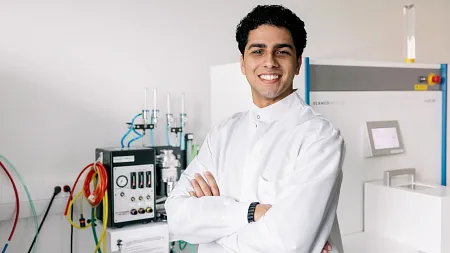
HUMAN PHYSIOLOGY - When he was still an undergraduate, Tucker Orman served in an uncommon role: as first author on a paper published Sept. 4 in the European Journal of Applied Physiology, looking at the factors that affect a scuba diver’s ability to maintain core body temperature. Now a College of Arts and Sciences alumnus, Orman reflects on how experiential learning as a human physiology student and love for scuba diving came together.
PHYSICS - On Nov. 14, Congresswoman Andrea Salinas (D-OR) visited the University of Oregon Eugene campus to meet with Presidential Chair in Science and Professor of Chemistry Geraldine Richmond, interim Vice President for Research and Innovation, and faculty from the Oregon Center for Optical, Molecular, and Quantum Science (OMQ). During her visit, the congresswoman learned more about College of Arts and Sciences faculty research and academic offerings in quantum science.
ASIAN STUDIES - Professor Alisa Freedman explains how pop-culture trends like Labubus become a global phenomenon. “I think Labubu represents a very different Gen Z or Gen Alpha, even, way of consuming media,” she said. “For example, they might learn about trends by following celebrity influencers and watching short, attention-grabbing videos.”
Researchers in the College of Arts and Sciences secured $83 million in sponsored grants to fund 199 research projects across the three divisions: Humanities, Natural Sciences, and Social Sciences. This year’s annual report provides a glimpse into the curious minds of researchers and their work.
POLITICAL SCIENCE - Sarah Koski graduated with a degree in political science in 2006 from the University of Oregon College of Arts and Sciences and Robert D. Clark Honors College. To find her purpose and mission, Koski first had to break up with the notion that all success is a high-powered executive job. Now a community resource liaison for Lane Transit District, Koski works to help people feel seen and heard, and to make real change in the unhoused community.
PHYSICS - Far from home, Eric Torrence, a physics professor at the University of Oregon College of Arts and Sciences, will spend the next year and a half being the ATLAS Run Coordinator at the European Organization for Nuclear Research (CERN). After being elected to the position fall 2024, Torrence ensures the largest particle accelerator in the world continuously produces usable data from May 2025 to July 2026.
COMPUTER SCIENCE - Assistant Professor Yu Wang's research uses machine learning to model enormous sets of data on a graph where related nodes representing pieces of information are linked. “With current AI, if you ask who the president of the United States is, it can definitely answer correctly,” Wang explains. “But if you ask any kind of domain-specific question, like related to cybersecurity or some biomedical topic, it is highly likely that it does not know. So how can we mitigate the gap here?”
CINEMA STUDIES - CAS senior Elle Thompson is a cinema studies major who's had multiple internships to get experience and exposure to different parts of the cinema industry. She landed a casting internship with Cast Iron Studios thanks to a cinema studies course and her persistence.
PHYSICS - University of Oregon College of Arts and Sciences physicists Eric Corwin and Ben McMorran were awarded 2025 American Physical Society Fellowships. Corwin was recognized for his outstanding contributions to the physics of the glass and jamming transitions using simulations and experiments. McMorran was recognized for his contributions to electron matter wave physics.
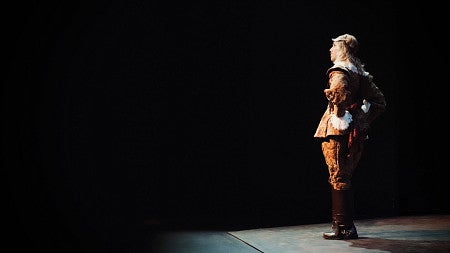
ENGLISH, DIGITAL HUMANITIES — In 2024, the National Endowment for the Humanities awarded $350,000 for the continued development of the London Stage Database, a groundbreaking digital catalog of theater events in London during the 18th century. Learn about the importance of this digital humanities project and its impact on researchers and ancestry sleuths everywhere.
EARTH SCIENCES - In spring 2025, Marli Miller received a Herman Award for Specialized Pedagogy. Taking a liberal arts approach, Miller’s focus is on helping students think about and work through problems, which they have a chance to put into practice on a yearly field camp in southwestern Montana.
SOCIOLOGY - New research co-authored by CAS sociology assistant professor Byron Villacis Cruz explores the forces that influenced Ecuador to adopt the dollar in 2000, which impacted the country on social and economic levels — and what it teaches us about future policies around the world.
GLOBAL STUDIES — Learning about and engaging in the world got a little easier for students at University of Oregon thanks to a grant from the US Department of Education awarded to the Schnitzer School of Global Studies and Languages. The grant funds are being used to strengthen curriculum for current students and attract the next generation of globally minded students from Oregon high schools. 
PHYSICS — College of Arts and Sciences physicists are part of a US Department of Defense three-year research endeavor — funded for $1.245 million — with the University of California, Los Angeles and Massachusetts Institute of Technology. Researchers are tasked with expanding the capabilities of an advanced computing system that could be the key to new scientific frontiers.